 |
ROUND DANCING — CHOREOGRAPHED BALLROOMEDUCATIONAL ARTICLESMAJOR SECTIONS: Figures | Articles | Links | Alph. Index | Search | Home |
|
|
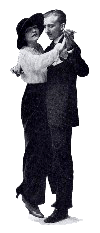
Blend To Banjoby Harold & Meredith Sears Do you ever feel that it takes a special effort to get yourself into banjo position? Do you take a side step, do you shift to the side, do you shove your partner more to your right? There is no need to rush, or to move laterally at all, to get from closed position to banjo. The only movement you need is a little right-face rotation and left-side lead. Let’s do a Foxtrot Feather. We know that the Feather is designed to move us into banjo position so that the man can step outside his partner on her right side. We might begin in closed position facing line of dance with trail feet free. Now in closed position, our first step pretty much has to be forward right for the man between her feet and back left for the woman. The wrong way to continue a Feather would be to then step side left in order to shift to the side and get the woman clearly on the man’s right. Now the man could take his third step, forward right, and easily step outside the woman, his right hip maybe touching her right hip. He sort of accomplished his goal of being able to step outside of his partner, but that wasn’t a Feather, and this isn’t banjo position. We shouldn’t make that second step a side step. We shouldn’t even step side and forward. All three steps should be straight forward but with a little right-face, upper-body rotation. The feet continue to move down line, but the belly button gradually shifts to point toward line and wall (woman, reverse and center). By shifting the man’s left side forward and the woman’s right side back, the man becomes able to slip his right foot to the outside of the woman’s right foot without really leaving closed position. Banjo is not a side-by-side position; it is a kind of closed position with a twist in the hips and upper body.It’s important not to do this rotation through the arms. We shouldn’t feel as though we are steering a big rig down the highway. The movement really comes up out of the hips. Rotate your hips to the right, and your whole frame shapes or shifts as a unit. In closed position, the man is looking at the woman’s right elbow. As he shapes and blends to banjo, he comes to be looking at the back of her right hand. His head didn’t move — his nose is still positioned over his toes, and both are directed down line, but the frame has shaped to the right between these two stationary points. If he had shaped a little farther right, his nose and toes would still be pointing down line, but he would be looking at the back of his own left hand in semi-closed position. Does this procedure sound somehow picky, complicated, or difficult? The charm of this approach really lies in its simplicity, its minimal nature. There are no big steps, no “getting out of her way,” no jerking or tugging or pushing on your partner. All we need in order to blend to banjo is a little rotation, a little side lead. Let’s try an Open Natural Turn — sometimes we think of this figure as a Maneuver to banjo instead of to closed. This time we might be in semi-closed position facing line of dance with trail feet free. We both step forward down line of dance. The man begins to turn to the right, and his second step is side left across the line of dance (woman forward right to momentary closed position). In this figure, we do need the second step to be a side step for the man because he is moving from the inside to the outside of the circle, but in keeping with our minimalist theme, we want a small side step. Don’t leap across, trying to get “outside” of partner. That would be too big, too rough. Just get in front of her to closed position facing reverse. Now comes the “blend to banjo.” The man steps straight back but with the right-face rotation. He moves his right hip back. The woman steps forward left with left-side lead. This body rotation allows us to keep our hips together. Our shoulders remain parallel. We are still dancing together, rather than off to one side of each other. But we are in banjo position. Our angled bodies allow the next step to be outside partner.
This article was published in Round Notes (CRDA), p. 5, Feb/Mar 2008, in the North Carolina Round Dance Association newsletter p. 6, August 2008, and in Dixie Round Dance Council, 47-10:12, 11/2008.
If you would like to read other articles on dance position, technique, styling, and specific dance rhythms, you may visit the article TOC. If you are not a member of DRDC, do consider joining. The group sponsors triquarterly weekends with great dancing and teaching, and the newsletter is one of the most informative available. Past DRDC Educational Articles archived here. Go beyond this site. Find other references on our Sources and Links pages.
|
 |
|
|
Page last revised