|
|
Foxtrot—
4 beats/measure; 28-34 meas/min
At the beginning of the 20th Century, few in the US danced.
Those who did danced the Waltz, Polka, and Two Step. But in 1910,
ragtime music was bringing unprecedented numbers of dancers into the
dance halls. Especially, a whole flock of "animal dances" were briefly
popular, formed out of the earlier Two Step. There was the Squirrel, in
which dancers took small, mincing steps, a Duck Waddle involving quick
walks and sways of the upper body to the left and right, a Snake, where
dancers walked sinuously to banjo with a dip and then to sidecar. There
was the Lame Duck, Chicken Scratch, Kangaroo Hop, a Horse Canter, and a
Horse Trot. And of course, there was the Fox Trot.
However, the Fox Trot might not actually have started as an
"animal dance." One story tells of Harry Fox, a burlesque comic and a
part of the Ziegfeld Follies of 1913, who worked on a stage scattered
with scantily clad women in static poses. His act involved a fast,
comical dance to 4/4 ragtime music from one woman to the next where he
would deliver his jokes. The act was popular, the music was widely
marketed, and Fox's "Trot" became popular in dance halls and dance
studios. It was introduced to members of the Imperial Society of
Teachers of Dancing in London in 1915.
In these earliest days, the Fox Trot was not the smooth: slow,
quick, quick, of today (which if you think about it, is nothing like a
"trot"). Back then dancers might have taken four slow steps down line
and then eight quicks with just a little bit of a prance. They walked
in a circle. There was a lunge, close, lunge, close; producing a full
turn. There were hops, kicks, and capers. There was a definite
strutting or trotting look. One of the first "definitions" of the
rhythm came from an American teacher who said, "There are but two
things to remember; first a slow walk, two counts to a step; second a
trot or run, one count to each step."
But Vernon and Irene Castle and other teachers wrote new
figures for the rhythm, and by 1916, the Fox Trot had evolved into the
Foxtrot, a slower, more elegant, floating kind of dance.
During the Jazz Age of the 20s, the Foxtrot was sped up again.
It acquired some of the jazzy hops and skips of the Charleston and
became our present-day Quickstep. Of course, the Quickstep didn't
replace the Foxtrot, but joined it, a close cousin. The existence of
the Quickstep maybe allowed the Foxtrot itself to slow back down. In
England, the Foxtrot was danced at 48 measures per minute in 1927, at
42 in 1928, and between 38 and 42 in 1929. The Quickstep was being
danced at 54 to 56. By 1932, the Foxtrot tempo was down to 36 measures
per minute.
Foxtrot uses long passing steps that keep the dancer up,
stretched, and extended. It has a gentle rise and fall but not as much
as that of Waltz, where the third closing step causes you to lower more
dramatically. (Where Waltz is "mountains and valleys," Foxtrot is
"rolling hills," and Tango is "as flat as Kansas.") In three steps, we
step heel, toe rising, toe, toe, heel lowering again.
The passing steps encourage us to keep moving, too. We want
fluidity, continuity; a graceful, steady glide. Even when checking a
movement or when in a picture figure, where your feet have stopped, we
keep the body flowing. We introduce sway, change the sway, change it
again if we have the time, incorporate arm and hand movements that
extend these body movements, and then flow right on out into the next
figure. The long, gliding steps of the slow Foxtrot give an impression
of elegant ease, but control and balance are required to maintain that
smooth flow.
Still another sophisticated feature that developeed in Foxtrot
involved angled bodies so that dancers aren't directly facing or
backing the line of progression; they are angling or slicing down the
hall. I think of a barge plowing forward, directly into the wind and
current, "breasting" the waves. The Foxtrot doesn't do that. Dancers
progress at a graceful angle, slicing through, with one or the other
side leading.
The
slow, elegant, gliding Foxtrot is a rich and sophisticated rhythm
and is one of the most popular dances ever. The Foxtrot seems more
sustainable, less intense, than the Waltz for instance. Maybe it is
the slow count that gives us a little rest in each measure. Certainly,
the "slow, quick, quick" rhythm and the more subtle downbeats on 1 and
3 (and upbeats on 2 and 4) provide more variety and interest than the
steady "1, 2, 3" and
strong, regular downbeat on 1 that we find in Waltz. Where the
feel of waltz music has been described as "BOOM, cha, cha," the feel of
foxtrot is more like "BOOM-cha, BOOM-cha." Maybe it is the
soaring glide of Foxtrot that feels so good, compared to Waltz's more
dramatic rise and fall.
Regardless of your personal reaction, the Foxtrot has
developed and matured over the last hundred years into a wonderful and
engaging rhythm, and if we occasionally think back to the silly and
slightly bawdy beginnings with Harry Fox, we might have even more fun.
Figure Name, Roundalab Phase
Level, & Timing
q=quick, 1 beat
s=slow, 2 beats
&=1/2 beat; a=1/4 beat |
Steps and Actions That Make Up
the Figure
Each description focuses on the man,
with the woman's footwork in parenthesis. If a woman's step is not
given, it is the natural opposite or follow of the man's. Help: basic dance
positions and steps,
actions, directions, and abbreviations. Non-standard punctuation: a
comma separates two beats of music, a semi-colon marks the end of a
measure, and a slash (/) indicates a split beat, two things occurring
in a single beat.
|
Here are some sequences to help
you visualize the figure in context.
|
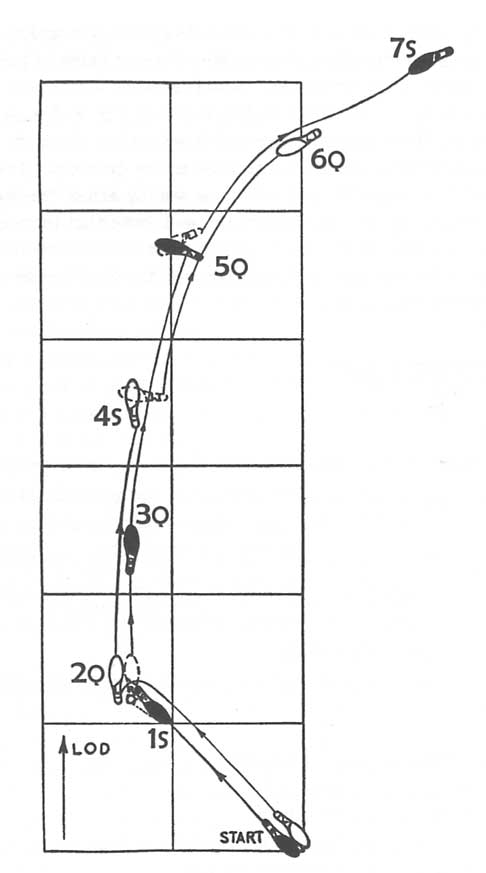
| Three Step
phase IV
sqq;
|
In closed or banjo position facing line of
dance, step forward L (W bk R), -, fwd, fwd;
Curve these steps just a little to the left, and end in
closed position, even if you didn't begin that way.
Properly, this figure is unusual among foxtrot figures
in starting with two heel leads. Most foxtrot figures begin
with a step, heel to toe, giving early rise, and then the second step
is toe, maintaining that rise. The second step of a three step is
heel/toe, driving kind of under partner and producing a late rise. The
third step is then toe/heel as usual.
|
The Scotts' Steppin Out with My Baby,
has a diamond turn;; three step to closed position; half natural turn;
closed impetus; and box finish;
Here is a lesson from Flow Dance Studios that shows the feather, reverse turn, three step, natural weave, and change of direction.
A detailed look by Egils Smagris,
at the feather; reverse turn;; three step; then the reverse turn half;
tumble turn; feather finish; and finally the feather; reverse turn
half; tumble turn; back to promenade sway; oversway; change sway &
hover out to SCP;
|
Back Three Step
phase IV
sqq;
|
In CP or in BJO, step bk R
(W fwd L), -, bk L, bk R ending in CP;
As the man does in a three step, the woman takes her first two steps
with a heel lead.
|
In Love Wonderful Love by Ross, part A
begins with a reverse wave;; back feather; back three step; hesitation
change; telemark to semi;
|
| Forward, Run
Two
phase III
sqq;
|
In closed or banjo position facing line of
dance, step forward L (W bk R), -, fwd, fwd;
May begin with either foot.
|
In My
Kind Of Girl by Kirsch, the dance begins with together touch;
box finish; fwd run 2 twice;; reverse turn;; three step; half natural;
|
| Box
phase III
sqq; sqq;
|
In closed position with lead feet free, step forward L (W back R), -,
side,
close; back, -, side, close;
Each half of this figure can be separately cued: a Forward Half Box;
and a Back Half Box.
|
Follow with a hover to semi; through, -,
face, close back to closed position;
In It's D'Lovely by Kincaid,
there is a maneuver; spin turn; back half box; diamond turn;;;;
|
| Progressive Box
phase III
sqq; sqq;
|
In closed position with lead feet free,
step forward (W back), -, side, close; fwd, -, side, close; |
|
Box Finish
phase III
sqq;
|
In CP, step bk R (W fwd L)
turning up to 1/4 LF, -, sd L, cl R;
Note that the box finish turns; the back half box does not.
|
|
| Left Turning Box
phase III
sqq; sqq; sqq; sqq;
|
In closed position, line of dance, step
forward & turn 1/4 left, -, side, close; back & turn left, -,
side, close; forward & turn left, -, side, close; back & turn
left, -, side, close; (face each wall of the room in turn) |
In Why Don't You Spend the Night?
by the Matthews, there is a hover; pickup side close; left turning
box;;;; 3 cross hovers;;; to a maneuver side close; |
| Diamond
Turn
phase IV
sqq; sqq; sqq; sqq;
|
Step forward and turn left to diagonal
center, -, side continue left, back to banjo position (turn 1/4 left
each measure, facing each corner of room in turn); back, -, side,
forward; for, -, side, back; back, -, side, for; |
In Pop Goes the Movies by Raye we begin part B with a diamond turn;;; CP LOD; fwd & run 2 (sqq) 2X;; 2 left turns; hover;
In Valenta's Bye Bye Baby, there is a quarter
diamond turn to a feather finish;; and again;;
|
| Quick Diamond Four
phase IV
qqqq;
|
In banjo, step forward L (woman back R)
and turning LF, side R, back L, back R; You will end in a position that
will be cued. |
The Rumbles' That's You has a
diamond turn one half;; quick diamond four to closed position line and
wall; dip back, -, recover, -;
Another neat sequence from LeBlanc's Remember When
is a quick diamond in four progressing down line and ending facing
reverse; dip back, -, recover, -; quick diamond in four to reverse; dip
back, -, recover, -; to a 3-step down line;
|
| Fox Trot Wheel
sqq; sqq;
|
In banjo position, lead feet free, circle
one full turn: fwd, -, fwd, fwd; fwd, -, fwd, fwd; |
Start diagonal wall, do the wheel;; change
of direction; closed telemark; maneuver; |
Right
Turns
phase III
sqq; sqq;
|
In CP LOD step fwd R
turning 1/4 RF (W bk L), -, sd & bk L across line of progression to
CP RLOD, cl R to L; bk L trng 1/4 RF, sd & fwd R trng to CP LOD, cl
L to R;
|
|
| Natural
Turn
phase IV
sqq; sqq;
|
In closed position facing diagonal line of
dance and wall, lower and step forward R (W back L) leading a RF turn
with the hips, -, step forward and side thru woman and across line of
dance leading the woman's heel turn, step back to closed position
facing reverse (W fwd L); step back turning RF, -, step side, step
forward to closed position DLC;
A full natural turn is not as common as one might think.
We more often hear Half Natural; and then something else, such as a
heel pull.
In all right-turning figures, the actual foot turn tends
to be early, accompanied by upper-body turn. (In left-turning figures,
upper-body turn precedes foot turn, and the foot turn is late.) So
here, the man begins with his toes pointing toward DLW. He signals a
right turn with upper body rotation, but at the same time allows his
foot to turn as he steps forward R. As he takes weight, his toes are
already pointing toward the wall. Foot turn has occurred early, before
the step has even been taken. This is comfortable because the woman is
naturally on his right side and so on the inside of the turn, as he
dances around her.
|
In the Valentas' Was That the Human
Thing To Do, part A begins with a three step; half natural turn;
closed impetus; feather finish overturned to diagonal reverse and
center checking; top spin; reverse wave check and weave;;;
In All In A Night's Work by Molitoris and
Firstenburg, there is a hover telemark; and a slow half natural
checking to a weave;;; hover telemark; to in & out runs;;
This half natural is interesting in that it is danced
slow, slow, slow, checking on that third step, and then we weave 6
quicks.
Ballroom tutorial of a natural hover cross from Egils Smagris. which includes a close-up of a wonderful heel
turn by the lady.
|
| Open Natural Turn
phase IV
sqq;
|
From closed, banjo, or semi, step forward
right turning RF, side across line of dance, and back to contra banjo
reverse. |
In the Cunninghams' I Found You Just
in Time, part A begins with a three step; open natural; open
impetus; in & out runs;; to a promenade weave;; |
| Running Open Natural
phase V
sq&q;
|
This is an Open Natural Turn with an extra
step, a syncopated Open Natural.
In semi-closed position facing line and wall, step thru
R (woman thru L) beginning to turn RF, -, side and back L with left
side stretch/back R with right-side lead, back L with slight right-side
stretch to end in contra banjo facing RLOD;
|
In Nearness Of You by the
Cantrells, part A begins with a hover; feather; reverse turn;; three
step; running open natural; feather finish; change of direction; to a
reverse wave;; |
| In
and Out Runs
phase IV
sqq; sqq;
|
In SCP LOD, step forward right turning
RF, -, side and back left to closed position diagonal reverse and
center woman forward right between man's feet, back right to contra
banjo; back left turning RF, -, side and forward right between woman's
feet continuing to turn, and then forward left to semi-closed position,
line.
A little more sophisticated version has us doing the first "run" not to
BJO RLOD but to RSCP LOD. We both step through on step 4, and we end in
SCP with a little easier, smoother turn, and the body line of RSCP is
quite elegant.
Another option is to begin in BJO LOD, take it to BJO RLOD, and then to
BJO LOD, again.
|
In the Woodruffs' Wonderful Wonderful,
there is a hover telemark; fwd hover to banjo; bk hover to semi; in and
out runs twice;;;; chair and slip to closed line and center; |
| Open In and Out Runs
sqq; sqq;
|
In half open position facing line of
dance, step forward R (W fwd L) turning RF, -, side & back L across
in front of W turning with slight sway to the right (W fwd R), sd &
fwd R turning to left half open facing LOD; fwd L turning RF slightly (W fwd R
turning RF more strongly), -, sd & fwd R turning slightly (W sd & bk across in front
of M), sd & fwd L to half open facing LOD;
Notice that the woman is not at all holding back or
dancing in place to allow the man to get across. She is dancing
forward, as is the man in the second measure. Those steps are much like
a man's hover telemark: fwd, fwd, fwd, turning RF. If she does hold
back, then when he gets across, he will tend to "scoop her up" in his
left arm, and the resulting push will not feel good to her.
|
In Breathless by the Moores,
there is a telemark to half open; open in & out runs;; running open
natural; to a reverse wave ending; |
| Reverse
Turn
phase IV
sqq; sqq;
|
In closed position or banjo facing line of
dance, step forward L with right-side lead. This lead will turn the
body about 1/4 LF. Step forward and side R through the woman turning LF
a total of 1/2 and leading a heel turn for the woman, and back L to
closed position facing reverse; back R turning LF, side and forward L,
and forward R to contra banjo facing line and wall.
The common error is for the man to dance down line and
think that he has to dance "around" his lady. If you do this, she will
be led to progress, will not be able to do the heel turn, and you will
end in banjo at the end of the first measure (I speak from long
experience). Instead, take steps 1 & 2 DLC, turning your body as
you move through her left side; dance a straight line, not a curved
path around her.
Remember too that foxtrot has early rise. Begin each figure with a
slight lowering action but rise by the end of the first step. Making
your turn in this "up" position will stop the woman's progression and
help to lead her heel turn. In contrast, in waltz, we extend our rise
over the first two steps. This more gradual rise lets the woman step
back and then side in a Left Turn, and there is no heel turn. |
Broadwater's Dream of Me has a
reverse turn;; three step; half natural; closed impetus;
In If I Had My Way by Slater
we do a feather finish DLC; top spin DLW; change of dir; reverse trn;;
hover; feather;
Here is a lesson from Flow Dance Studios that shows the feather, reverse turn, three step, natural weave, and change of direction.
A detailed look by Egils Smagris,
at the feather; reverse turn;; three step; then the reverse turn half;
tumble turn; feather finish; and finally the feather; reverse turn
half; tumble turn; back to promenade sway; oversway; change sway &
hover out to SCP;
|
| Open Reverse Turn
phase IV
sqq;
|
In closed position, banjo, or semi-closed,
step forward left turning LF, forward and side turning, and back to
contra banjo reverse and center.
Notice that in a reverse turn, there is a heel turn and
so less progression down line. In an open reverse, there is no heel
turn by the woman and so more progression.
|
In the Scotts' Hand Over Your Heart,
part B begins with a diamond turn 1/2 checking;; open impetus; chair
& slip; open reverse; hover corte; back whisk; and pickup, -, side,
close; |
| Quick
Open Reverse
phase V
sq&q;
|
We want to do an open reverse turn, but we
have the trail foot free. In semi, we step thru with the trail and she
begins to turn LF, -, forward L to closed position and both
turning/side and back R turning to face reverse and center, and back L
to banjo reverse; |
In the Rumbles' Change Partners,
part B begins with a hover; quick open reverse; outside check to banjo
facing reverse and wall; and back & chasse to sidecar facing line; |
| Solo Reverse Turn
sqq;
|
This is a reverse turn done not as a
couple but individually. You might be in shadow position facing LOD,
both with the left foot free (the woman will be doing a man's reverse
turn). Step fwd L turning LF, -, sd & fwd R turning to face RLOD,
and bk L to end in left open position both facing RLOD; |
In the Shibatas' Orange Colored Sky,
there is a shadow fishtail; solo reverse turn; and feather finish woman
transition to banjo DLW; for a 3-step; |
| Reverse Wave
phase IV
sqq; sqq;
|
This is half a reverse turn and then a
curving, back three-step. In closed position, step forward L turning
LF. She draws L to R as he steps side R leading a heel turn, she
closes. On beat four, step back L (woman fwd R) to closed position
diagonal reverse and center. During the second measure, step back R,
back L curving LF, back R curving, to closed position RLOD. That
curving path in the second measure is the "wave" (the curve of an ocean
wave?)
It is interesting to compare the open telemark, the
first measure of a reverse turn, and the first measure of a reverse
wave. All three figures begin with the same lowering into a forward
step and a rising into another forward that leads a lady's heel turn.
You stay in closed position through these three beats of music, and you
turn as a couple. In the open telemark, you turn 1/2, from diagonal
center to diagonal reverse and wall. In the reverse turn, you turn 3/8,
stopping so that the man faces reverse. In the reverse wave, you only
turn 1/4, ending diagonal reverse and center, so you can do the curving
"wave" part during the second measure.
|
Do a reverse wave;; back feather; back
feather finish; three step;
In Call Me by the Collipis,
there is a chair recover slip; reverse wave 3; slow sway right and
left;; feather finish; three step;
|
Wave Ending
sqq;
|
In closed position facing
DRC with trail feet free, step back R, -,
back L curving LF, back R curving to closed position RLOD;
This is the second measure of the standard reverse wave and is
sometimes danced by itself.
|
|
Four Waves
sqq; sqq; sqq; sqq; |
In CP DLC, step fwd L (W
bk R) commencing LF body turn, -, sd R M fcg COH and cont. to turn, bk
L to CP DRC; bk R curvg LF, -, bk L cont curv LF, bk R to CP
RLOD; bk L, -, bk R with rgt sd leading, bk L; bk R with slight CBM, -,
bk L with left sd leading, bk R end’g CP RLOD;
|
In On A Little Street In Singapore
by Valenta, there is a small change of direction to CP LOD; four
waves;;;;
back tipple chasse pivot to CP DRW; to an extended nat weave end [8Qs]
to BJO DLW;;
|
| Lilt
phase V
qq
|
In semi-closed position with soft knees,
step forward R (woman fwd L), close L to R rising onto toes but keeping
knees bent,
Try hard not to bounce. This is a soft and gentle "down,
up."
May be done from closed, banjo, or sidecar positions.
|
In the Moores' Breathless, they
have a reverse wave 3; check & weave 2; double back lilt; to a
weave ending; and a three step;
Here, the double back lilt begins with the man's L and
the count is s&s&;
|
| Lilt Pivot
phase V
s&
|
In semi-closed position with soft knees,
step forward R rising and turning a little LF (woman fwd L rising and
turning LF in a pick-up action to closed position), -/fwd L lowering
and pivoting a little LF,
The man turns left to lead the pickup, but often he
really doesn't pivot much. The "pivot" in this lilt pivot is really the
woman's as she turns to face him.
|
In Irresponsible Me by the
Nelsons, part B begins with a whisk; curved feather checking; outside
swivel lilt pivot; to a right lunge roll and slip; |
| Change Of Direction
phase IV
sqq;
|
In closed position facing diagonal line
and wall, step forward L (W bk R) and then forward R turning LF up to
1/4. Draw lead foot and touch to face line and center (only two weight
changes, end with lead foot free). |
In Just
In Time by Shibata, the dance begins in BFLY SCAR DRW with check
lady develope; inside underarm trn; chg of dir; rev wave;;
Here is a lesson from Flow Dance Studios that shows the feather, reverse turn, three step, natural weave, and change of direction.
|
| Drag Hesitation
phase IV
ss;
|
In closed position facing line of dance,
step forward L (W back R) beginning to turn LF, -, side R continuing to
turn and draw left to right ending in contra banjo position facing
diagonal reverse and center with lead feet free, -;
May begin in other facing positions. Total turn is about
3/8.
|
In Molitoris' Really Mine, part B
begins with an open impetus; feather; double reverse spin; drag
hesitation; back twist vine 4; and hesitation change; |
| Hesitation
Change
phase IV
sqq;
|
In closed position facing RLOD, step back
L turning RF, -, step side continuing to turn, rise draw and touch to
face DLC; (only two weight changes, lead foot free)
May begin in other facing positions. Total turn varies
from 1/8 to 1/2.
|
In the Woodruffs' Christmas Island,
there is a telemark to semi; overturned maneuver, side, back;
hesitation change; to a diamond turn 1/4; and outside check; |
| Heel Pull
phase IV
ss;
|
This is a hesitation change with a
modification to reduce the amount of progression.
In closed position facing diagonal reverse and center,
step back L turning RF, -, continue to turn on your left heel as you
draw your right heel toward your left and change weight (woman side L
and draw R to L no weight) , -;
End in closed position, usually facing line and center,
although the amount of turn can vary. Feet should be a little apart
(second step not a true "close"). Given that separation, you should be
down in the knees, without the tendency to rise, as at the end of a
heel turn. Lead feet are free.
|
Hurd figure clinic (mp4) on hover telemark, heel pull, and curved feather (at 0:00)
|
| Close Point
q&
|
In any position, bring the free foot to
the weighted foot, take weight, and extend the newly free foot to the
side and point the toe. |
This isn't particularly standard for
foxtrot, but it is a
great action to use if you find yourself with the wrong foot free for
the next figure. |
| Jete Point
phase V
&q
|
From
SCP and on the "&" of the previous beat, step fwd L (W fwd R trng
to fc M or "picking up" on the lead foot)
with a bit of a springing action and sharply lowering into the knee. On
the beat (the "q"), extend the trail foot to the side
with the inside edge of the foot in contact with the floor. Sway and
look in the direction of the extended foot.
Often, this figure is done from SCP with the trail feet free, and the
cue is "thru to jete point." Here, we can rise on the thru step and get
a nice sharp leap and lower during the figure itself. (Don't overdo; we
want elegant, not Tigger-like.)
Note that the figure is one-and-a-half beats only, but it creates quite
a picture.
Therefore, choreographers often use a full measure ("jete point &
hold") or end the dance with this figure, where we have lingering notes
to develop the extension and the sway.
May be done from other positions and in any facing direction. One may
spring onto the trail foot and extend the lead (although I have never
done it).
|
In In A Mellow Tone by the
Sandemans, there is a half natural; spin turn overturned; back chasse
to banjo; curved feather check; outside change to semi; thru jete
point; fallaway ronde & slip; curving 3-step; back curving 3-step;
hover telemark; |
| Pickup
sqq;
|
Properly,
a pickup is a phase II waltz
figure in which you step forward down line in semi-closed position, and
the lady turns LF to closed position LOD or DLC. Complete the measure
with a side step on the lead foot and a close trail to lead foot.
Notice that there is no suggestion in this description that the woman
should step across in
front of the man as she turns. The "pickup" step is a straight step
down whatever line
of progression you are traveling and a turn to face. This puts her
neatly on his right side in good closed position.
Can be danced from other positions, e.g., OP, and in other facing
directions.
|
Do a hover; pickup; reverse wave;; |
| Slow Side Lock
phase IV
sqq;
|
This is the proper foxtrot pickup. In
semi-closed position, step thru with the trail foot. Step side and
forward to closed position, and then cross right in back of left,
turning slightly LF (woman crosses L in front of R). |
In the Hartungs' White Lilacs,
there is an open reverse turn; outside check; open impetus; slow side
lock; to a diamond turn;;;; |
| Rising Lock
phase V
sqq;
|
This is a pickup starting from closed
position facing RLOD. Your trail feet are free. Step back R (woman
forward L) beginning to turn LF, -, side and forward L, cross R in back
of L (woman XLIF of R) ending in closed position facing line and
center;
Starting position and amount of turn can vary.
|
|
| Turning Lock
phase V
q&qs;
|
In tight contra banjo position facing
reverse and wall, step back R (woman fwd L) with right side lead and
right side stretch/cross L in front of R (woman XRIB of L), back R
turning LF, side and forward L to end in contra banjo facing line and
wall;
Sometimes cued Left Turning Lock to distinguish it from
the Right Turning Lock.
|
|
| Right Turning Lock
phase V
q&qs;
|
In closed position usually facing RLOD,
lower into the lead knee, begin to turn your frame RF, and small step
back R (woman fwd L) with right-side back. That is, get that right hip
out of the woman's way. Having begun to turn, this first step takes on
a crossing-behind feel. The second step [on the "&" count] is the
lock. Continue to turn and cross L in front of R (woman XRIB of L). The
man will be facing COH at this point. On count "2" continue turning,
initiate left-side stretch, and small step fwd R between woman's feet
(woman larger step side L staying well into man's right arm). Finally,
complete the turn like a small pivot, use right-side stretch to open heads to semi-closed
position, and step fwd L in SCP facing DLC. |
In I Like To Lead When I Dance
by Vogt, the ending begins with a telemark to SCP; open natural;
outside spin to right turning lock;; thru ripple chasse; slo sd lk;
When you hear that stacked cue, outsd spin to R trng lk, you know to
overturn the outsd spin to face RLOD and to keep that rotation going
into the R trng lk.
Egils Smagris
lesson on open natural turn, right turning lock, and checked natural
& slip. As is often the case, the ballroom terminology is a little
different, but the demonstration is crystal clear. Slow the video and
look closely. You may also consider the lady's ballroom shaping.
I'm not sure what to say there.
|
| Whiplash
phase IV
ss;
|
In semi-closed position, trail feet free,
step thru, turning body RF (woman LF) to closed position. On the second
"slow" point the lead feet and hold. Sometimes, the music might tell
you to step and sharply ronde the lead foot, like the crack of a whip,
leaving a little extra time to shape to your partner and then sway away
from that extended lead leg.
Increasingly, we are being cued to "Whiplash to Banjo."
Usually, this means banjo facing approximately LOD, so the woman
swivels almost 1/2 and the man only shapes a little left to lead her
swivel and then right to contra banjo position.
A refinement to the whiplash to BJO is for the man to
step thru with right sway and a right head folding her to CP DLW but
with the intention of leading her outside partner on the next step. So,
we whiplash to CP, and with a little LF rotation, we achieve BJO to
begin the next figure.
|
A whiplash to CP wall might be followed by
a fallaway ronde & slip. A whiplash to BJO DLW might be followed by
a back whisk.
In the Sechrists' Believe Me, part
B begins with a natural weave;; reverse wave; back to a slow throwaway
oversway;; link to semi; open natural; outside swivel and whiplash;
Shibata's This Can't Be Love has a hover to
semi; whiplash and freeze; quick change sway and check back; double
reverse;
|
| Maneuver
phase III
sqq;
|
In closed position facing LOD, step
forward R and turn 1/4 RF, -, side L and turn 1/4 , close R; |
In La
Vie En Rose by Molitoris, part A begins with fwd run 2;
maneuver; spin turn; box finish; 2 left turns;;
|
| Pivot
ss;
|
In closed position reverse, step back L
turning 1/2 RF. Having left the right leg extended between the woman's
feet, step forward R continuing the turn for a full turn over one
measure. This figure does progress down line. It is important for both
partners to step well under the other and to change places completely
with each step.
This figure might be cued, "Pivot Two." As you might
imagine, a choreographer might ask for any number of these one-step
actions (depending on how sadistic…)
|
If you do make the full turn, you can
pivot again and again. If you don't quite make it, you'll fall behind.
In Just In Time by Shibata, we
dance diamond turn 3/4;;; bk to hinge M fc COH; lady rec & pivot 2
to LOD (full); right lunge roll & slip DLC;
In I'd Do Anything by
Palmquist we dance a rev trn;; three stp; half nat trn; pivot 3 [SQQ];
nat weave;;
|
| Pivot
Right Face Double
phase IV
ss; ss;
|
I don't think I've ever heard
this cue. This is a Pivot Four.
In closed position facing reverse, step back L turning
1/2 RF. Having left the right leg extended between the woman's feet,
step forward R continuing the turn for a full turn over one measure. Do
it again.
One key to success is to stay low, with soft knees. Once
you rise, you stop turning. Another thing to think about is that each
step, especially that forward step right (man or woman) should be taken
down line. You might be tense and worried (panicky?) about getting
around, but don't rush your steps. Let yourself rotate and don't step
forward right until you can do so down line.
I recently ran across another point, about footwork; I'm
not sure how useful it might turn out to be. Normally, we think of a
back step as being taken "toe-heel" and we will do that automatically,
without thinking about "footwork." This teacher suggested that we dance
our back steps in the pivot "toe-heel-toe" and that we let the left
heel barely kiss the floor as we turn and push off with the left toe
into the forward right step. I'm going to try to remember to think
about that the next time we dance a pivot 4 or a pivot 6 and see if
that little detail might help the figure flow.
|
|
| Reverse
Pivot
phase VI
q or &
|
In closed position facing RLOD, step back
R (woman fwd L between M's feet) and spin to the left on the ball of
the right foot.
Stay low—no rise or fall and no sway.
Or in CP LOD rotate LF and step fwd L between W's feet spinning LF.
May progress LOD (as above) or RLOD. Amount of turn is usually 1/2 but
may vary. Ends in CP unless otherwise cued. Multiple reverse pivots
alternate the actions described above.
|
In The
Best Is Yet To Come by Preskitt, there is a change of direction;
telefeather;; left feather ; ,, reverse pivot ,; hover;
In Jeanie and Shenandoah by
Ross there is a reverse fallaway & slip to LOD; reverse pivot 2 to
wall; side to a throwaway oversway;
|
| Slip Pivot
phase III
sqq;
|
The word "pivot" is not only used to refer
to a couple action. Here, the woman pivots, but the man does not. In
semi-closed position, step back on lead feet, the woman beginning a LF
pivot on the ball of her right foot (her thighs locked and left leg
extended forward). On the first quick, the man steps back R turning LF,
and the woman steps forward L, completing about a 1/2 LF turn, placing
her foot just outside his right foot. Finally, he steps forward L in
closed position. Of course, the "pivot" is the lady's LF turn on the
ball of her right foot. The "slip" is the smooth turning action, the
sneaking of her left foot against his right, and the neat change to
closed position.
There is a general rule associated with slip movements
that says, if there is no or only a little LF rotation of the couple,
then the woman steps L outside the man's R. The man will use his frame
to control this. If the man intends to turn the partnership, say, 1/4
LF, then he will guide her to step L between his feet. This will allow
him to turn LF during the third step and end in closed position. If she
had slipped outside his feet, the turn would have put them in banjo.
|
In the Springers' Stardust Foxtrot,
there is an open telemark; hover fallaway; slip pivot; manuver; and two
right turns;; |
| Outside
Change
phase IV
sqq;
|
In closed or banjo reverse, step back L,
back R turning LF, and side and forward to banjo or semi, line of
dance. The woman will step forward R, forward, and then either side and
back to banjo or side and forward to semi, depending on the lead (and
cue). |
In Am I
Blue IV
by Slater, there is a promenade weave;; change of direction; turn left
& right chasse; outside change to SCP; half natural; closed impetus;
|
| Outside Check
phase IV
sqq;
|
In closed position RLOD step back R, -,
side and forward L turning LF, and then check forward R to banjo
reverse and wall;
May begin in other facing directions and turn varying amounts.
|
In Lefeavers' Christmas Candles,
part B has a reverse wave;; back 3-step; outside check to banjo reverse
and wall; back hover telemark; to a promenade weave;; |
| Outside Swivel
phase IV
ss;
|
In banjo, step back L, woman forward R.
The woman then turns RF on the ball of her right foot while the man
crosses his right foot in front of his left to get that leg out of her
way. Only one weight change; end in SCP, trail foot free.
Although
not standard, we can dance an outside swivel from SCP beginning with
the trail foot. Both step forward, M right and W left, and the lady
swivels LF to BJO. Sometimes, the cue is "outside swivel twice." We
begin in BJO. The man rocks back and forward, and the lady dances a
forward swivel to SCP and another forward swivel to BJO. |
In the Fishers' C'est Si Bon, part
A has a closed telemark; open natural; outside swivel twice; impetus to
semi; |
Inside Swivel
ss; | In
CP, step back L, bringing R side strongly back, taking R hip out of the
lady's way. She steps forward R between his feet and swivels on the
ball of her R to a tight SCP. |
|
| Cross Swivel
phase IV
sqq;
|
In closed position facing LOD, step
forward left turning LF (W bk R), -, both point trail feet toward line
and continue to turn, and finally check thru to banjo reverse (two
weight changes, lead feet free at the end). |
In the Moores' Just In Time, there
is a three step; natural turn; back feather; back feather to sidecar
checking; cross swivel to banjo; maneuver and pivot 3 to semi; to a
whiplash; |
| Traveling Swivel
phase VI
qqqq;
|
In closed position facing LOD, step
forward L (woman bk R) turning LF with left sway, sd R swiveling LF
(woman close L), back L stepping toward line and center swiveling LF
and leaving right foot forward (woman fwd R outside partner flick left
foot up in back from the knee and swivel RF to semi-closed), thru R
(woman thru L) toward line and wall to end in semi-closed position; |
|
| Spin
Turn
phase III
sqq;
|
In closed position facing reverse, step
back L (woman fwd R) pivoting RF, -, forward between lady’s feet rising
and completing the turn, recover side and back to CP DLW;
A second standard ending position is CP DRW, a turn of 7/8. The
preferred cue is Spin Overturn.
Again, the standard figure ends DLW (5/8 turn), but the
figure
may underturn to face LOD or overturn to face reverse and wall or even
RLOD. When the amount of turn wanted is other than 5/8 or 7/8, the cue
should be, spin turn to a particular facing direction, such as wall.
The figure can begin in other facing directions, such as
CP LOD. We'd end facing DRC. I find it surprisingly difficult to do
this. I suppose it's because it doesn't happen often.
|
Do a spin turn to a back half box; and
three step down line; |
Spin Overturn
aka Overspin Turn
phase III
sqq;
|
In closed position facing reverse, step
back L (woman fwd R) pivoting RF, -, forward between lady’s feet rising
and completing the turn, recover side and back;
End facing reverse and wall.
Sometimes, dancers feel that they can't get far enough
around when they are asked to overturn a spin turn. The secret is in
the second step. First, ladies, keep a strong left head. This will add
to your turning momentum. If you pull in to your man, you can stop the
rotation dead. Second, milk that beat (beat 3 of the measure). Don't be
in a hurry to put your lead foot down. Ride the spin until you are
where you need to be, and only then recover onto the lead feet. If that
isn't until the "&" of beat 4, that's okay. Don't even think about
that third step, and certainly don't plan a leaping or lunging side
step at the end, thinking that this might take your farther around. The
woman drives as she steps forward on her right. The man drives as he
steps forward on his right. Right here, think of your frame as a
rectangle, instead of an oval, and ladies, put your head in that back
left corner. Then ride the momentum around. Let the free lead leg just
hover behind the weighted leg, and you should actually feel the need to
put the brakes on as you spin even to RLOD.
|
In the LeBlancs' Remember When,
part B ends with a 3-step; maneuver; overspin turn to wall; back half
box; and then into a jive sequence. |
| Running
Spin
phase VI
sq&q;
|
The term "running" implies the syncopation
in this figure. It is a syncopated Overspin Turn.
In closed position facing RLOD, step back L (woman fwd
R) pivoting 1/2 RF, -, fwd R turning/side L (woman bk L/sd R), bk R to
contra banjo facing reverse and wall;
|
In To
Each His Own by Shawver we dance a three stp; half nat trn;
running spin; outside chg to SCP; curved feather;
|
| Spin and Twist
phase VI
sqq; q&qs;
|
In closed position, reverse line of dance,
lead feet free, step back commencing RF pivot, -, step forward between
lady's feet turning, and step side to face diagonal reverse and wall;
During this first measure, you are dancing an overspin turn.
Now, the trail feet are free. The man hooks his R behind
his L with no weight, and she steps fwd L/R around him. On beat 2, she
steps fwd L turning RF and unwinding him. He changes weight as she does
so. On the last "slow," he steps side and back L, and she steps between
his feet R. End in closed position facing diagonal wall, wall, or even
diagonal reverse and wall.
|
|
| Spin and Double Twist
phase VI
sqq; q&qs; q&qs;
|
Do a spin and twist (see above) overturned
to face reverse, and then do another twist turn.
One of the problems inherent in this "double twist turn"
lies in the long side step L that overturns the first twist turn and
prepares you to do the second twist turn. It can become an abrupt leap
that disturbs the smooth flow of the dance. Again, a twist turn for the
man involves two weight changes. He crosses his right behind his left.
She unwinds him. He takes weight on his right on beat 2, and then steps
side on the "slow." You can smooth out a double twist by taking four
weight changes and by making the third step a progressing pivoting
step. Cross R behind L taking weight/step L as she begins to unwind
you. On beat 2 step forward R and pivot in a maneuver action, and then
step small side L to set up for the second twist turn. The count
becomes q&qs; just as it is for the woman, and the flow is so much
smoother than the usual "hook/unwind, step, leap."
|
|
| Twist
Turn
q&qs;
|
This figure is perhaps most often found as
a part of the Spin and Twist (above), but it can stand alone following
other figures than the Spin Turn.
Begin in closed position, trail feet free. The man
crosses his R behind his L with no weight, and she steps fwd L/R around
him. On beat 2, she steps fwd L turning RF and unwinding him. He
changes weight as she does so. On the slow count, he steps side and
back L, and she steps between his feet R. May also end in semi-closed
position.
|
In the Cantrells' All Of You,
part A begins in closed position with a forward to a right lunge;
recover, step, double ronde and twist turn;; to a feather; into three
fallaways;;; |
| Natural Twist Turn
phase VI
sqq; sqq;
|
In semi-closed position facing LOD, step
forward R (woman fwd L) turning RF, -, side and back L (woman fwd R
between man's feet) to closed position facing RLOD with right sway,
cross R in back of L with no weight change (woman fwd L in contra banjo
position); unwind RF shifting weight to both feet (woman fwd R in
contra banjo), -, unwind and take weight on R (woman swivel RF on right
and close L to R), step back L (woman fwd R) to closed position facing
reverse and wall;
This is a "standard" figure but not a common one in
Foxtrot. Actually, the twist turn originated in Tango and only later
came to be danced in various combinations in other Smooth rhythms.
|
|
| Outside Spin
phase V
sqq;
|
This one begins in contra banjo, usually
facing reverse, lead feet free. The first thing the man does is use
upper body rotation and right side lead (back) to cause the woman to
take a big step forward, outside, and turning RF. In the process of
leading this movement, he takes a little step back, toeing in. Don't
think of taking a back step. Just let your weight shift to the left
foot, toe to the instep of the right foot, as you rotate about 3/8 RF.
The man's second step is a long forward step outside of the woman and
again turning about 3/8 RF. She draws her left to right and does a heel
turn. During the second quick, he steps side and back, and she steps
side and forward between his feet to closed position, completing one
full turn during the figure. Note that the woman takes a big step
first, the man second, and both step together on the third step. Some
teachers summarize these steps as: "lady around, man around, step side." |
In the Heinys" Must You Dance,
there is a hover to banjo; natural hover cross;; turn left & right
chasse; outside spin; feather finish; and hover to semi;
In the Finchs' Sam's Pants, there is a hover
telemark; open natural; outside spin overturned; to a hairpin;
|
| Royal
Spin
phase V
sqq;
|
This is somewhat like an Outside Spin for
the man, but his third step is forward, rather than side and back, and
he has to be careful to dance a circular arc. He can't move away and
then back toward his partner, or she'll topple.
Begin in contra banjo position facing reverse. As in the
Outside Spin, begin RF body rotation, and allow that movement to place
the left foot just a little back and L toe to R instep (woman turns
with the man, staying well into his right arm in contra banjo, and
steps forward R outside the man). Step forward R outside woman, turning
(woman continues to turn on ball of right foot over counts 2, 3, &
4, and as she spins, she makes a small CW ronde with her left foot,
raises the left knee to bring the left foot to the right knee, toes
pointed down, and then lowers the L to R with a touch). On the second
"quick" the man slips L under body and steps forward L with left-side
lead.
The woman is doing a sort-of "ronde/kick" that actually
aids considerably in causing the spin. She has just stepped forward R,
so the left leg is back. She makes a small ronde forward to a kick and
at the same time bends the knee so the left foot ends up at her right
knee. The movement is like a reverse develope superimposed on top of
the rotation. The momentum of the kick part really helps to rotate the
couple. It has a neat, wooshing kind of feel.
Again, the woman takes only one step and then rises to
her leg flourish, as the man turns her on the spot. For this figure to
be stable, each of his steps must be the same distance from her pivot
point. He must walk a circle, the center of which is the ball of her
right foot.
|
|
| Impetus
to Semi
phase III
sqq;
|
In closed position facing reverse, step
back L and she steps forward R between the man's feet. The man brings
his R to L and touches and leads her to step L thru his right hip,
turning him in a heel turn 1/2. The effect will be much as though she
pushed through a turnstyle. Don't close on the right too early, or you
will lock that turnstyle. Close at the end of beat three. Then open her
head with a little right side stretch and step forward L to semi-closed
position, diagonal line and center. |
In the Rumbles' This Is the Life,
there is an impetus to semi; promenade weave;; three step; natural
turn; closed impetus; to a back feather finish; |
| Closed Impetus
phase IV
sqq;
|
As in the impetus to semi or "open"
impetus, in closed position reverse, step back L leading woman to step
R between feet turning 1/2 RF and then side and forward L brushing
right to left. Man does heel turn, changing weight at the end of beat
3. On count 4, the man steps side and back, and woman steps side and
forward to closed position, diagonal line and wall. |
In the Goss' Nessuno Mai, there is
a three step; natural turn 1/2; closed impetus; feather finish; |
| Reverse Impetus Turn
phase V
sqq;
|
In closed position facing RLOD, step back
R beginning to turn LF (woman fwd L), -, draw L to R for a heel turn
sway right and close L (woman side R rising and brush L to R) turning
1/2 LF, continue turning LF on ball of L and step back R (woman fwd L)
to end facing DRC; |
In They
Say It's Wonderful by Doi, there is a quick weave 4 to BJO RLOD;
reverse impetus to BJO DRC; bk & pivot to a hairpin;
|
| Hover
phase III
sqq;
|
In
closed position, man facing wall, step forward L (W bk R), -, forward
& a little side R rising to the ball of the foot, side & fwd L
to SCP LOD;
The second step, rising, and perhaps
prolonging that step, by borrowing just a bit from the previous or from
the next step, is the "hovering" action. You float on air for a moment
and may brush lead to trail foot. May be done from other facing
directions, but the effect is a little LF turn. (Contrast with the
hover telemark, which tends to direct us a little RF.)
May start in banjo position -- blend to CP during the first step. May
be danced from other facing directions.
|
In Once
In A While by the Gloodts, there is a curved feather checking;
back feather; feather finish; hover; slow side lock; double reverse
spin;
|
| Back Hover
phase III
sqq;
|
In closed position, step back, -, side and
back (W sd and fwd & brush free foot to supporting foot) with a
slight rise, recover to closed position.
May start with either foot. May begin and end in other
positions in which case the woman may have some body turn. For
instance, in a Back Hover to Semi, she would turn RF.
|
In the Broadwaters' Dream of Me,
the dance begins in left open facing position, diagonal line and
center, with a back hover to semi; feather; reverse turn;; three step;
half natural; closed impetus; |
| Cross Hover
phase III
sqq;
|
In sidecar position, step fwd L (W bk R)
with slight crossing action and beginning to rise and turn LF, -, side
and fwd R completing 1/4 turn, diagonally fwd L to banjo position
lowering at the end of the step;
This is a progressive figure with each step being taken
along a diagonal. May begin in banjo with the trail feet free. The
woman may brush her free foot to the supporting foot at the end of the
second step. The figure may end in semi-closed position if so cued. In
this case, the woman will turn strongly at the end of the second step
and her last step will be forward.
|
In the Bucks' Flamingo, there is
an open natural; outside spin & twist to diagonal reverse and
wall;; back and chasse to banjo; natural telemark; cross hover to semi;
promenade weave;; change of direction; |
| Forward Hover
phase III
sqq;
|
In closed position, step forward, -, side
and fwd rising, recover; |
In the Tuckers' Un P'tit Foxtrot,
there is an open natural turn; back, back/lock, back; open impetus;
forward hover to banjo; quick feather finish to banjo line and center;
to a reverse turn check and weave;;; |
| Closed Hover
sqq;
|
In closed position, step forward, -, close
rising, recover; |
In Kiss
Me Slow by the Nelsons, the dance begins with a closed hover;
feather finish; hover; feather; reverse wave check & weave;;;
|
| Running Hover
phase VI
sq&q;
|
The word "running" can imply quick steps
or it can mean to add a step to a figure through the use of
syncopation. In the running hover, we want to do a hover, but we have
the trail feet free. In banjo, we would step forward R (woman back L)
and then do a quick syncopated hover: fwd L to closed position/ fwd
& sd R with right side stretch, and fwd L;
The figure could begin and end in a variety of positions.
|
|
| Hover
Telemark
phase IV
sqq;
|
I like to think of this figure as a hover with an open
telemark ending. It also involves a forward step thru the woman, which
is an important part of telemark turns.
In closed position, step forward L (woman back R), side
and forward R into the woman turning up to 1/4 RF and woman brushing R
to L. Both step small step forward on lead feet to semi-closed position.
You might consider dancing this with qsq timing. This
would give you two beats to emphasize the hovering action and turn it
into a little picture.
Where the hover tends to lead into left-turning figures,
the hover telemark usually preceeds right-turning figures.
|
In the Rumbles' More, there is a
promenade weave;; hover telemark; open natural turn; outside swivel
twice; and weave ending;
Hurd figure clinic (mp4) on hover telemark, heel pull, and curved feather (at 0:00)
|
| Back Hover Telemark
phase IV
sqq;
|
In closed position facing reverse line of
dance, step back L (W fwd R) turning RF. Step side and fwd, rising and
continuing to turn; brush if you like. Small step to semi facing
diagonal line and center, trail feet free.
The beginning orientation can vary. The man turns up to
3/8; the woman will turn more, up to 5/8.
I suppose this figure is named for the initial back step
and the hovering action and ending position of a hover telemark, but I
believe the ballroom world knows this figure as a Hover Impetus. It is
an impetus turn with a side step instead of a heel turn for the man.
|
In the Esquedas' Pensando En Ti,
there is a double reverse spin; change of direction; fallaway 4 to
banjo; back hover telemark to semi; and promenade weave;; |
| Link To Promenade
phase VI
sqq;
|
In banjo position, perhaps facing line and
wall, step forward R with slight right sway (woman back L turning RF),
-, draw L to R, fwd L rising to toes and with left sway to open woman's
head (woman fwd R);
May begin in other positions and orientations, so first
step may vary. The essence is to move from some other position in two
steps to semi-closed position, trail feet free.
|
|
| Hover
Corte
phase IV
sqq;
|
In closed position, reverse line of dance,
step back right turning LF, step side and forward left rising in a hovering action (lady brush L to R), and
recover right to contra banjo, line of dance. |
Booz's The Unicorn has this in
part A: three step; natural turn; spin turn; hover corte; reverse hover
corte; back box; two left turns;;
Hurd figure clinic (mp4) on waltz and foxtrot hover corte (at 33:30)
|
| Reverse Corte
phase VI
sqq;
|
This is a Hover Corte in which the man
takes only one step. It can have an elegant, soaring feel. It is also more compact, staying in one place after the first step.
In closed position, perhaps facing RLOD, step back R
(woman fwd L) turning LF, -, continue to turn on the right foot now
with right sway (woman small fwd R turning), turn to contra banjo and touch L
to R (woman close L to R);
|
|
| Reverse Hover Corte
sqq;
|
Not a standard figure, but in The
Unicorn, it is a mirror image of a hover corte. Booz's spin turn
puts you facing diagonal line and wall. The hover corte turns 1/2 LF to
banjo diagonal reverse and center. The reverse hover corte then steps
back L behinning a RF turn, a side R rising in a hover action, and then
a back L to sidecar diagonal line and center for a 1/4 RF turn. The use
of the word "reverse" is unfortunate here, since we usually think of a
left-turning action, and here it is used to mean the opposite of a
regular hover corte, which is a LF action. Oh well—there you are. We
have to be flexible. |
In Where Or When by Scott we dance a quick open reverse; hover corte; reverse hover corte; feather finish; double reverse;
I must admit that when I cue this dance I cue the figure as a "natural hover corte." Is that very bad?
|
| Whisk
phase III
sqq;
|
In closed position facing wall, step
forward L (W bk R), -, side rising to ball of foot, both hook behind;
End in a
tight semi-closed position, high on the balls of the feet, trail foot
free.
A nice little refinement has the man stepping forward L with left-side
lead. This turns the lady just a little and causes her second step to
be back L, rather than side L. All three of her steps then become back
steps, and she stays on the man's right side much better.
|
The Tullus' Kiss Me Goodbye begins
with a whisk; feather; to a reverse wave check and weave;;; three step; |
| Back Whisk
phase IV
sqq;
|
In closed position, step back L (woman fwd
R), back and side, and both cross lead behind trail in semi-closed
position. |
|
| Back Turning Whisk
phase V
sqq;
|
In contra banjo position facing reverse,
step back L toward diagonal wall and turning RF (woman fwd R), -, side
R continuing to turn to semi-closed position facing diagonal center,
and cross lead in back of trail; |
In the Nelsons' The Rose, in
semi-closed position, there is a thru hover to banjo; back turning
whisk; feather; to three fallaways with feather finish;;;; |
| Left Whisk
phase IV
sqq;
|
In semi-closed position, trail feet free,
step thru, -, side to momentary closed position, and then cross well
behind to a reverse semi-closed position;
As you take steps 2 & 3, your hips will be turning
RF (woman LF), but your upper body should lag behind, producing a
strong LF "wind-up" in the torso. Stay flat - does not have the strong
rise of the normal whisk.
|
|
| Syncopated Whisk
phase V
sq&q;
|
In semi-closed position, step thru with
the trail foot, -, close and face partner/step side with slight right
side stretch, and cross lead behind trail in tight semi-closed position; |
In the Goss' From My Guy, there is
a reverrse turn;; whisk; syncopated whisk; wing; reverse turn to
sidecar check & weave;;; |
| Natural Fallaway Whisk
phase V
qqqq;
|
Remember that "natural" means turn right,
a "fallaway" is a step back in semi-closed position, and a "whisk" is
that tight tucking of the lead foot behind the trail foot.
Start this figure in semi-closed position facing LOD.
Step thru R turning RF to closed position facing reverse and wall
(woman thru L), side and back L continuing to turn (woman fwd R between
man's feet and staying well into his right arm still in closed
position), side and back R turning (woman sd L), cross L tightly in
back of R with strong right-side stretch (woman XRIB of L) to a tight
semi-closed "whisk" position facing RLOD;
|
|
| Wing
phase III
sqq;
|
In semi-closed position facing LOD or DLC,
step thru with trail feet, draw L to R with no weight change, the woman
walking forward around man turning LF. End in sidecar, line and center.
The man takes one weight change and the woman takes three.
An
important consideration in any figure that puts you
into sidecar is to maintain your dance position. Sidecar is considered
to be a kind of closed position, so the man needs to rotate his torso
left face and keep upper bodies in a closed relationship, even as he
shifts his hips to the right, to their sidecar relationship. The woman
turns her body sharply LF between steps 2 & 3 and closes her head.
The figure is called a "wing" because the lady's part
resembles a large bird, maybe a sea gull, folding it's wing into it's
body (the man). (Josephine Bradley) We do not want to see the lady's
body and head directed straight ahead or even off to the right
somewhere, but center on your partner.
|
In Hover Dreams IV by the
Meyers, there is an open reverse turn; hover corte; back whisk; thru
& chasse to SCP; wing; and cross hover 3 times ending in SCP;;; |
| Progressive Wing
phase IV
sqq;
|
In semi line, step thru with trail feet.
The man turns his upper body LF to lead woman to walk in a semi-circle,
LF around in front of man as he steps forward L and then locks RBL to
end in a contra sidecar position. Same as a plain wing (just above),
but the man takes three steps and progresses down line. |
|
| Closed Wing
phase IV
sqq;
|
In closed or banjo, diagonal line and
wall, step forward right wih LF upper body turn, leading woman back
left, -, side right across man, and forward left to sidecar. |
|
| Right
Lunge
phase IV
s
|
In closed position trail feet free, flex
left knee lowering, step side and forward between her feet, flex right
knee, rotate body a bit LF, and look at partner.
First, a caution. Men, we spend most of our time with
head left. We are looking up, but her right elbow or right hand might
be in the bottom of our field of view. When you are told that you may
"look at partner," we usually mean only that you may shift your gaze a
little farther right, maybe over her right ear. Don't get in her face
to probe deeply those limpid pools, searching out her very soul. I
suppose at the end of a dance, you might give in a little, but
generally we want to stay in closed position and maintain proper frame.
Keep your torso up. Don't invade her space and push her over.
Second, note that you step between her feet. Your goal
is to contact the inside of her left thigh with your right knee and to
gently ease her leg out there. If the two of you step to the side
independently, it is easy to go different directions and to end up
apart from each other. We want to end a right lunge tight together.
|
In Love Wonderful Love by the
Rosses, the dance begins in closed position with a right lunge recover;
feather finish; reverse wave;; back feather; back three step;
hesitation change; telemark to semi; |
| Rolling Right Lunge
s
|
This is a right lunge in which left sway
is accentuated at the beginning of the figure, and then smoothly the
sway is changed.
In closed position with right-side stretch and woman's
head to her right, flex left knee lowering, step side and forward R
between her feet, flex right knee, rotate body a bit LF, change from
right- to left-side stretch closing her head, and look at partner. Your
frame should slowly "roll" from left to right sway.
|
In That's How It Goes by the
Vogts, the dance ends with a natural hover cross checking;; topspin 3
to a rolling right lunge; and hold;
In this dance, the figure extends into the last measure
and actually spans 5 beats, rather than just a "slow."
|
| Right Lunge Roll and Slip
phase V
sqq;
|
Begin in closed position, often facing
line and wall, with the trail feet free. On the slow count, flex the
left knee and lower, step side and slightly forward R between her feet
(woman steps side and back L), flex the right knee, and stretch the
left side to produce a little right sway. The sway will close her head:
she will look left and he will look right. On the first "quick," rotate
the upper body up to 3/8 RF, lowering just a little more to help you
get your lower body back under yourself, and recover L rising and
rotating LF. This is the "roll." Then slip the right foot past the left
for a back R (woman draws L to R and slips forward L) turning LF and
lowering again to closed position facing line and center.
We find this a complex figure. There is footwork, rise
and fall, rotation to the right and then to the left, and there is
right sway and then loss of sway—all layered on top of one another. The
steps are side and forward R, -, recover L, back R;—straightforward.
The lunge uses beats 1 & 2. The right sway is part of the lunge—we
are inclined to the right and looking right (woman left). So the sway
develops in beat 2 and goes away during 3. The rotation is layered over
the lunge, the recover, and the slip; so it uses beats 2, 3, & 4,
first to the right and then to the left. Finally, the rise and fall
extends over the whole measure. We lower during beat 1, stay down
during 2 and even try to lower a little more as we finish the roll. As
we recover during beat 3, we rise (this is very late rise for foxtrot).
Finally, we slip back to a lowered position at the end of beat 4. The
whole thing has a sort-of figure-eight, roller-coaster kind of feel to
it—very exciting when it all comes together.
|
|
| Right Lunge Rag Doll Sways and Slip
sqq; qq
|
Begin in closed position, often facing
line and wall, with the trail feet free. On the slow count, flex the
left knee and lower, step side and slightly forward R between her feet
(woman steps side and back L), flex the right knee, and stretch the
left side to produce a little right sway. The sway will close her head:
she will look left and he will look right.
The rag doll sways us the first three "quicks." Recover
L (woman R) and sway left, fwd R sway right, rec L sway left.
Finally, slip the right foot past the left for a back R
(woman draws L to R and slips forward L) turning LF and lowering again
to closed position facing line and center.
|
In I'm All Right by the
Cantrells, there is a double reverse spin; fwd, right lunge; rag doll
sways & slip; to a left curving 3; |
| Chair
phase III movement
s
|
In semi-closed position, lunge thru with
trail feet, heel-toe, and lower. Angle your foot out toward partner for
balance. Be sure to maintain your semi-closed position, rather than
easing into some kind of half-open position. That means your inside
thighs should be touching, and your shoulders should be turned toward
your partner in good toned, contra frame. But as always, keep your
upper bodies up and even arched back a bit: hips together, upper bodies
apart. Arms up. May be done with lead feet to reverse. |
The Slotsves' September Foxtrot
has a simple but really nice sequence in part A: hover; chair, -,
recover, -; promenade weave;; three-step; natural turn; closed impetus;
and feather finish;
I love the feel of that slow chair and recover.
|
| Broken Chair or Chair and Change Sway
ss;
|
The Chair (above) has definite forward
poise. It is a lunge thru. If you then sway to reverse by
looking at your partner or even over the trail shoulders, you can
change from a forward poise to a back poise, perhaps on the last beat
of a dance. |
|
| Chair and Slip
phase IV
sqq;
|
In semi, line, check thru with the trail
feet in a lunging action, recover with slight LF upper body turn
leading woman to swivel LF on right. Slip right behind left as woman
steps forward left outside man's right foot to closed position diagonal
line and center. |
Do a reverse turn;; hover telemark; chair
& slip; telemark to semi;
Or, the Bucks' Fools Fall In Love has a hover;
chair & slip; to diamond turns;;;;
|
| Contra
Check
phase V
s
|
In closed position, lead feet free, lower
into your right knee (woman left), begin LF rotation, and slide the
left foot forward. Your left foot is moving forward as your right side
is leading strongly. This is the contra body action. Of course, the
woman is lowering and stepping back R, allowing her toe to slip across
the floor. His left thigh is actually pushing into her right thigh.
Only when she feels the man stop and begin to change weight, will she
stop that slipping foot movement and take weight herself. She must
wait. The LF rotation causes the man to turn his left foot out. If he
is facing DLW, his toes will be pointing LOD. This angled foot
placement helps a great deal in maintaining balance. The woman steps
straight back R, but her CBM causes her left foot to angle out and may
turn her right foot a bit in. All four feet end up pretty much in one
straight row (her R, his L, her L, his R), but the foot angles and the
tight contact at the thighs helps maintain balance. Hips are in.
Toplines are well apart—you are stepping forward, but don't lean
forward. Heads are left.
There are two things that the man can think about to
make this figure more comfortable for the woman. First, he can relax
his right arm, slide his hand down toward the small of her back, and
let her go. If he keeps his hand on her shoulder blade and his arm
flexed, she will not be able to arch back and rotate left as freely.
Second, he can rotate his whole frame left, which means his left arm
will come back. We don't want to pull the left hand back separately in
a broken-chicken-wing effect. Maintain the same relationship between
the left arm and the shoulders as usual, but rotate the whole
assemblage. I often find myself rotating my torso but leaving my left
arm and hand forward. This pushes on the woman and again interferes
with her rotation and contra action.
Timing varies. A slow contra check can easily span a
whole measure.
|
|
| Contra Check and Slip
phase V
sqq;
|
In closed position, lower into the right
knee (woman L), begin to rotate upper body LF, and step forward L
(woman back R). Keep your hips in and up and your shoulders well apart.
On the first "quick" recover R, and then slip back L (woman fwd R). |
|
| Contra Check and Switch
phase V
sqq;
|
In closed position, lower into the right
knee (woman L), begin to rotate upper body LF, and step forward L
(woman back R) in strong contra-body position. Keep your hips in and up
and your shoulders well apart. On the first "quick" recover R beginning
to turn RF, and then slip back L (woman fwd R) continuing to turn about
1/4. |
In Where Or When by the
Worlocks, we have a good example of a one-step switch, but it is not
associated with a contra check. Part A begins with a promenade weave 5
with a check back on the trail foot and a slow switch;; to a natural
weave;;
In this dance, the "switch" is a slow forward L for the
man turning 1/2 RF to face LOD for the standard natural weave.
|
| Traveling Contra Check
phase VI
sqq;
|
In closed position perhaps facing line and
wall, step forward L with right-side lead (woman bk L turning RF)
[contra body motion], -, close R rising to toes, fwd L to end in
semi-closed position; |
|
Open
Contra Check
s
|
An open contra check is
the same as a standard contra check (see above), but we are apart from
partner, usually in a R/R handshake position. We dance the same
lowering, LF rotation, and sliding under partner, but we have that
handshake-worth of distance between us. We have only one point of
contact to direct our lead and follow, so maintaining our toned frame
is maybe even more important than in the standard, closed-position
contra check. Keep the joined right hands and arms well toned and
connected to the upper-body frame. Don't tug or push as in an
arm-wrestling match.
We lower. The man moves forward with right-shoulder lead, under the
lady, though at a distance, and the lady slides her lead foot back. She
feels the pressure through joined right hands, and she continues to
reach back as long as she feels the man moving forward. She can feel
that through toned right arms. She reaches back as far as she can. As
he takes weight and she feels the forward pressure weaken, she takes
weight. Of course, it is so important that she not simply take a short
back step and end the figure.
As we take weight, we usually now have time to develop the body lines.
Left arms are extended. The man straightens his right elbow; this is
analogous to the relaxing of his right arm in closed position. She
stretches to her left and looks well left out along her extended left
arm. We might have a whole measure, even two measures to create this
long, graceful line across the whole partnership.
|
|
| Chasse
phase III
(pronounce "sha-SAY" — a "sashay" is a square dance term)
q&q
|
In French, chasse is a chase, chasing,
pursuit. Chasse is a ballet term and refers to one foot "chasing" the
other. In round dancing, the steps are side/close, side, and may begin
with either foot. Partners are facing each other with shoulders
parallel. |
In That's How It Goes by the
Vogts, part A begins with a curving 3 step; back chasse to banjo DLW;
curved feather; back tipple chasse pivot; pivot 3; to a rudolph ronde
& slip; to an open telemark; |
| Thru Chasse
phase III
sq/&q;
|
In semi-closed position, step thru with
trail feet in CBMP, -, side/close, side; |
|
| Turn Left and Right Chasse
phase III
sq/&q;
|
In closed position, LOD, step forward L
(woman back R) turning LF, -, sd/cl, sd ending BJO reverse and COH; |
In Stardust Foxtrot by the
Bucks, there is a hover telemark; open natural turn; hesitation change;
turn left & right chasse to banjo; bk & bk/lk bk; to an outside
change to SCP; |
| Ripple Chasse
phase V
sq&q;
|
In semi-closed position, step thru R
(woman thru L) to contra banjo. The chasse begins with a side and
forward L/close R with left side stretch and looking R (woman L)
("closed heads"). This stretch is the "ripple:" tipping the upper body
in the direction away from that of progression. Finally, step side and
forward L again blending to semi-closed position. May also end in
contra banjo. |
In the Worlocks' Where Or When,
there is a hover; thru ripple chasse; big top; double reverse to line
and wall; and change of direction; |
| Tipple Chasse
also cued Back Tipple Chasse
phase V
sq&q;
|
In closed position, reverse line of dance,
step back L (woman forward R) turning 1/4 RF. Step side R/close L with
slight left side stretch. This stretch is the "tipple:" tipping the
upper body in the direction of progression. Finally, step side and
forward R with another 1/8 turn to face line and center in closed
position.
May begin with the trail foot in which case the turn
would be LF and the ending position line and wall.
Notice that this description includes both sway in the
direction of progression and body turn. Some teachers do not emphasize
the sway and instead think of a Tipple Chasse as a "turning" chasse.
|
|
| Forward Tipple Chasse
phase V
sq&q;
|
In contra banjo or closed position facing
LOD, step forward R turning RF, -, side L/close R with right-side
stretch, side and slightly back L to end in closed position facing
reverse and wall;
Again, a "tipple" is a sway toward the direction of
progression. Bill Goss has described this action as stretching up to
look over a fence as you dance past. Maybe there's a nudist colony over
there?
|
|
| Tipple Chasse Pivot
sq&q;
|
This is not a standard figure but a
combination of the tipple chasse and a one-step pivoting action (phase
II) made on the last step of the chasse: step back L turning RF (or
back R turning LF), -, side/close turning 1/8, and then side and
forward pivoting 1/2 for a total turn of 7/8; |
In the Rumbles' Blue Moon, part A
begins with a reverse wave;; back tipple chasse pivot; impetus to semi;
promenade run (qqqq); thru & chasse to low butterfly; |
Vine
(Grapevine is the American Foxtrot name.)
phase III
sqq;
|
In closed position step side L (W sd R),
-, both step behind, side;
May begin with the trail feet and progress in the other
direction. A Front Vine begins by crossing in front.
May be done in OP, in which case, we might "vine apart
and then vine together."
Often in foxtrot, our vines are done in all quicks: Vine
4 or even Vine 8.
|
In A
Wink and A Smile
by Rumble we are in wrapped position LOD. We rock L&R; lady roll
across to lunge apart M in 2; both roll across 3 to OP LOD; front vine
4; feather; three step;
|
| Twisty Vine
phase III
sqq;
|
In closed or butterfly position, step side
left (woman side R), -, cross in back R (W XLIF of R) to sidecar
position, step side to facing position again;
This "foxtrot twisty vine" can run for any number of
measures.
|
Follow with a maneuver.
In I Could Write A Book by
Parker we dance an impetus to SCP; cross hesitation; back twist vine 4;
outside change to SCP; chair & slip; Note that here the vine
is qqqq.
|
Shadow
Grapevine
qqqq;
|
In a tight shadow
position, perhaps facing wall, with the lady's right hip firmly into
the man's right hand, both XRIF of L, sd L, XRIB of L, sd L;
Note the twist-vine feel.
May start with either foot and proceed in either direction.
|
|
Advanced Shadow Grapevine
qqqq;
|
In a tight shadow
position, perhaps facing wall, with the lady's right
hip firmly into the man's right hand, both XRIF of L, sd L, XRIB of L
allowing the W to shift to the M's left putting her L hip into his left
hand,
sd L;
Of course, the "advanced" feature of this figure is the extra body
rotation that allows the lady to shift from the man's right to his
left. In order to show off this shift from side to side, one might
prefer to continue the figure for 8 steps and so shift her left, then
right, then left again.
May start with either foot and proceed in either direction. |
In Sisters
by Goss, we do an impetus to SCP; inside underarm trans to shadow;
shadow feather; shadow telemark; advanced shadow grapevine 8;; lady
roll RF trans half open; feather;
|
| Switching Grapevine
qqqq; qqqq; qqqq; qqqq;
|
In American Foxtrot, the vine is often
referred to as a grapevine, and the switching grapevine is very
American: done in open position, perhaps both facing wall, both with
right feet free. In the nutshell, we do a front vine 4 moving toward
LOD, the woman rolls in 4 in front of the man to his left side, we do
another front vine 4, and then the man rolls in front of the woman back
to OP again.
We begin in open position, both facing the wall, both
with right feet free. We XRIF of L, sd L, XRIB of L, sd L; chk thru R
(W fwd R beginning to roll across changing sides), recover L (W fwd L
turning LF), sd R (W sd R trng), rec L (W sd L) to LOP both fc wall W
on M's L sd; XRIF of L, sd L, XRIB of L, sd L; fwd R beginning to roll
across changing sides (W chk thru R), fwd L turning LF (W recover L),
sd R trng (W sd R ), sd L (W rec L) to OP both fc wall M on W's L sd;
Can begin in LOP so the man would roll across first. Can
begin with the roll across and end with both front vine. Could begin
with the left feet free and progress RLOD or facing COH, again with
either foot free. American Foxtrot is very flexible.
|
In Sisters by the Gosses, there
is an impetus to semi; roll out transition to left open position, both
facing wall, right feet free; switching grapevine (front vine; man
across; front vine; woman across;) to a front vine 4;
In Exactly Like You Foxtrot by the Gosses,
there is a six-measure switching grapevine beginning in LOP wall, right
feet free, in which the man rolls across; front vine; woman across;
front vine; man across; front vine; into continuous cross checks with
lunge and arms (the end);;
|
| Zigzag
phase V in QS
qqqq;
aka:
Natural Promenade Zig Zag
|
In quickstep, the standard figure begins in SCP. We step thru
with the trail feet and turn 1/8 RF to contra sidecar position, -,
side L completing turn (W fwd R), back R turning LF 1/8 to contra
banjo (W fwd L outside partner turning); sd L with left-side stretch,
fwd R to contra banjo,
But the "zig zag" action is the alternate turning
between
banjo and sidecar as you progress, and this sequence is often used from
different starting positions. For instance, you might begin in CP or in
SCAR
LOD, lead feet free. Step fwd L turning LF (W bk R), sd R
turning, bk L in BJO, trn RF and step sd R to SCAR; In the
standard figure, the man is dancing
on the inside of the circle; in this variation, he is on the outside.
In another dance, you might begin in BJO DRW and step back L
(woman fwd R). Close R to L turning RF as woman steps fwd & sd L
turning RF. Step fwd L to SCAR DLW turning LF. On the last
quick, step side and back R turning LF to banjo diagonal reverse and
wall. It's like a twisty vine in two-step but more compact. |
In the Cantrells' Ain't That a Kick,
the introduction begins with a zigzag beginning DRW; back feather; feather finish;
and a change of direction to face DLC;
Later, they have a forward zigzag 8;; to a maneuver,
pivot 2 to a promenade sway;
|
| Hover
Fallaway
phase III
sqq;
|
In semi-closed position, line of dance,
step through with trail feet, -, step fwd on lead rising to ball of
foot checking, and recover back on trail foot still in semi; |
|
| Natural Hover Fallaway
phase IV
sqq;
|
In SCP LOD, step forward R with slight RF
body turn (W fwd L), forward L turning and rising to a hover, the lady
stepping between his feet and remaining in SCP, then recover
back on trail feet (the fallaway step). End SCP DRW.
Each step progresses down LOD; remain in SCP throughout. Amount of turn
may vary from 1/4 to 1/2.
|
In the Scotts' Warsaw Concerto,
the intro has a natural hover fallaway to a weave ending;; three
fallaways with feather finish;;;; double reverse; drag hesitation; open
impetus; |
| Reverse
Fallaway
phase IV
sqq;
|
To "fall away" is to step back in
semi-closed position. In the natural fallaway (above), we step down
line, turn RF, and step back to SCP facing reverse and wall. In the
reverse fallaway, we turn LF and step back to SCP facing DRC.
The reverse fallaway might begin in CP or BJO facing
DLC. From CP, step forward L (woman back R turning LF). Step side and
then cross lead feet behind trail into a tight SCP facing reverse.
The Reverse Fallaway from SCP LOD, begins with a step
forward on the trail feet turning LF, feeling like a loose pickup, man
forward L turning and woman back R turning, and then both step back on
the trail feet to SCP RLOD.
May be done in other facing directions. The amount of
turn is usually 3/8 LF.
|
In the Martins' Old Fashioned Foxtrot 6,
there is an open telemark; curved feather check; open impetus; feather;
reverse fallaway & slip to closed position line; double reverse
spin;
In the Bucks' Dance and Dream, there is a
double reverse spin; bounce reverse fallaway 4 to banjo; back hover
telemark; to a Viennese Cross;
|
| Extended Fallaway
sqq; qqqq;
|
To "extend" is to add steps, but the
choreographer must specify the details.
You might begin in SCP and step thru with trail feet
turning LF, -, forward L (woman back R) turning, both step back on
trail feet to SCP facing RLOD; XIB, sd, XIB, sd;
|
In Breathless by the Moores,
part B begins with a hover telemark; feather; and then counter
promenade to extended fallaway slip to banjo and back wing checking;;;
(sqqqqqqqqs) |
| Bounce Reverse Fallaway
qqs;
|
This is a reverse fallaway with a sharp
rise and fall incorporated into the individual steps.
In CP or BJO facing DLC step fwd L (W bk R) turning LF
and with strong rise, sd R DLC but body facing DRC (W bk L) sharply
lower, bk L with sharp rise (W bk R) in SCP RLOD, -;
In order to emphasize or to showcase the bounce, this
figure is often done in 4 steps (qqqq): "bounce reverse fallaway in 4"
or "bounce reverse fallaway and back." An additionsl back step on the
trail feet is taken. Another slight modification that emphasizes the
"up" part of the bounce is to dance the figure s&s&. With this
timing, we rise on the slow-counts and hold the up position just a
little, and then fall quickly on the &-counts.
Sometimes the directional cue (reverse) is omitted from
this figure and we only hear "bounce fallaway." If the choreography
places you facing DLC, it would be uncomfortable to do a right-turning
figure, so "reverse" does not need to be stated. Perhaps the reverse
fallaway is enough more common than the natural fallaway so it can be
considered to be the default—just something to be aware of—if you're
not told otherwise, turn it LF.
|
In Ain't That A Kick by the
Cantrells, we do a feather finish; change of direction; bounce reverse
fallaway & back to BJO DRW; weave ending; three step; |
| Reverse Fallaway and Slip
phase V
qqqq;
|
This is a quick Reverse Fallaway with one
more step on which you spin 1/2 LF to closed position. So, in closed
position facing line and center, step forward L, (woman back R) turning
LF, back R in semi-closed position facing RLOD, and then cross lead
behind trail tightly under body—this is the "fallaway." Tuck that lead
foot farther under the body than in a plain Reverse Fallaway in
preparation for the "slip" or slip pivot. On the last step, slip R past L toeing in
to a small back R (woman fwd L pulling left shoulder strongly back)
with LF body rotation, and turn 1/4 more LF softening R knee to closed
position facing line and wall.
In this figure, we are quite briefly in SCP RLOD. Normally, we would
both be looking in the same direction in that position, but here it is
helpful if the lady will keep her head closed (to her left), as she
folds LF into the slip. The head is heavy, and if it can lead that
rotation, the little pivot will be more comfortable.
|
In All I Do
by Moore we dance a feather finish to DLW; double top spin first to
RLOD and then to LOD;; change of direction; bounce reverse fallaway
& slip (S&S&); three step; half natural; change of
direction;
In this dance, the figure is syncopated and is styled with sharp rise
and fall (also see just below), but the four steps of the standard
figure are there.
|
| Bounce Reverse Fallaway & Slip
qqqq;
|
This is a reverse fallaway and slip with a
sharp rise and fall incorporated into the individual steps.
In CP or BJO facing DLC step fwd L (W bk R) turning LF
and with strong rise, sd R DLC but body facing DRC (W bk L) sharply
lower, bk L with sharp rise (W bk R) in SCP RLOD, slip R past L toeing
in to a small back step R (woman fwd L pulling left shoulder strongly
back) with LF body rotation, and turn 1/4 more LF softening R knee to
closed position facing line and wall;
In order to emphasize or to showcase the bounce, this
figure can be danced s&s&.
|
In Smoke Gets In Your Eyes by
the Rumbles, the dance starts with a bounce reverse fallaway and slip;
change of direction; telefeather;; three step;
In French Poodle by the Moores, there is a
three step; natural hover cross overturned to BJO DRW; top spin to BJO
DLC; bounce fallaway & slip; change of direction;
|
| Three Fallaways
phase VI
qqqq; qqqq; q
|
In CP DLC step fwd
L with R shoulder lead and with right-side stretch (W bk R turning LF).
Sd R to SCP RLOD and then back L well under the body. We still have
sway toward RLOD. This is our first of the three fallaways. On the 4th
Q, step back R turning LF and bring the lady to CP RLOD with no sway.
On beat 5, step back and side L with left-side stretch = right sway (W
side and back R) to RSCP facing RLOD, W on the outside of the circle.
Step back R well under body (W bk L). We have danced the second of our
three fallaways on counts 456. Now turn LF and step fwd L to CP
LOD with right-side stretch = left sway, side R turning; and back L
well under body to SCP RLOD. We have danced the third fallaway on
counts 789.
This figure is comfortably danced if we pay attention to our positions
and make our SCP and RSCP properly tight. Each roll across becomes a
tight slip and fold to the next position with little separation between
partners. Notice that the standard figure is linear, progressing down
LOD, first to SCP, then RSCP, and finally SCP, all facing RLOD.
If we start facing DLC and end RLOC, the total turn is 1 3/8. The
amount of turn may vary.
The timing of the figure can also vary. The standard timing used to be
SQQ; SQQ; SQQ; for a total of 3 measures, and so the current standard
timing would have been cued "quick" three fallaways. We might continue
to hear this cue, as a "helper" cue.
In the ballroom world, three fallaways is not a linear figure. It makes
conspicuous use of the diagonals, and you might enjoy this little
different shape. Specifically, the first four steps
progress toward diagonal line and center (DLC). Steps 5 & 6 go down
LOD,
and then steps 7, 8, & 9 move toward DLW. "Like the shape
of a frying pan," says one of our teachers. If you can imagine looking
at the pan in cross-section, edge-on, we dance down the slanted side of
the pan, across the flat bottom, and up the other side. We move
diagonally in and then diagonally out again. It's a gentle flow, the
changes from SCP to RSCP and back are a little easier, and it's a nice
alternative to straight down LOD.
Here is a detailed description that emphasizes the diagonals. In CP
DLC,
step forward L (W back R) turning LF 1/4 and with right side
stretch (woman left side). Step side R in SCP facing DRW, and cross
lead foot in back of trail foot. The second fallaway
begins with a step back R still toward DLC and turning to CP with no
sway. The woman steps forward L and slips to
closed; she is facing LOD. Step side L directly down LOD, now with
left side stretch, leading W to step side and back R to RSCP, and cross
trail foot in back of lead with a strong LF
"wind-up" in the torso as in a left whisk. The man is on the inside of
the circle. Finally, step forward L (woman back R) toward DLW
turning LF now with no sway. The man is rolling across to the outside
of the circle. Both step side with the trail foot and then cross the
lead foot behind to SCP facing DRC, still no sway and lady's head
therefore closed. The
total turn here is 1 1/4.
You might be tempted to dance the first and third
fallaways the same, but the ballroom figure is designed to consist of
three different
fallaways, the first with left sway and lady's open head, the second
with right sway, and
the third with no sway and lady's closed head.
|
In the Bahrs' Broken Hearts, part
C begins with a change of direction; quick three fallaways and feather
ending;;; to a three step; natural hover cross;; and double reverse
spin;
Hurd figure clinic (mp4) on three fallaways (at 19:40)
A slow-motion look at three fallaways by Domen Krapez & Natascha Karabey.
|
| Promenade Weave
phase IV
sqq; qqqq;
|
In semi-closed position facing diagonal
line and center, step forward R (woman forward L), -, forward L turning
a little LF to closed postion (woman sd & bk R). Turn & step
side and back R (woman fwd L) to banjo. Continue to turn LF, step back
L, back R to closed position wall, side and forward L, and forward R to
banjo position facing line and wall, lead feet free;
One of the problems in this figure arises if the man
tries to "pick up" the woman too soon. Don't take the first step and
try to fold her in front of you right away.
|
In part A of Prow's Every Street's a
Boulevard, we have a hover; start a promenade weave to banjo
reverse; outside swivels twice; and then finish the weave; to a hover
telemark; and a thru chasse to semi;
In the Worlocks' Where Or When, there is a
promenade weave 5 with a check and slow switch;; to a natural weave;;
|
| Weave Ending
qqqq;
|
Various "weaves" can put you in contra
banjo or in fallaway position facing reverse and wall at the end of the
first measure, but other figures can do the same. A Weave Ending lets
you weave out of a position that you didn't actually weave into in the
first place.
So, in banjo position facing reverse and wall, begin to
turn LF, step back L (woman fwd R), back R to closed position wall,
side and forward L, and forward R to contra-banjo facing line and wall,
lead feet free.
|
In the Rumbles' A Wink and A Smile,
they have an open telemark; curved feather check; outside swivel twice;
quick weave ending; to a hover; |
| Weave to Banjo or to Semi (sometimes,
"weave 6" or "foxtrot weave")
phase IV
sqq; sqq;
|
In semi-closed postion, diagonal line and
center, trail foot free, step forward R and then forward L, turning LF
to closed position center of hall. Step side and back, continuing to
turn, back L to banjo, reverse and center, back L turning to closed
wall, and finally forward L to banjo, line and wall. Figure may also
end in semi, in which case, during the last step, turn the woman to
semi. Her last step will be side and forward R, rather than side and
back. |
In the Scotts' Call Me Irresponsible,
part B has a hover; weave 6 to banjo;; half natural turn; and impetus
to semi;
In Pop Goes the Movies by Raye we dance a hover; weave 6 to BJO DLW; fwd fc cl to face wall; whisk;
|
| Natural
Weave
phase V
sqq; qqqq;
|
From closed line, banjo, or semi, the man
steps forward R turning RF, and the woman steps back L (from semi, she
will step forward L). In the second step, she draws R to L and he steps
side L with left side stretch leading a heel turn, she changes weight
at the end of the turn. At this point, her head is strongly closed, so
his head needs to be stongly left, too, to counterbalance her topline.
If the man looks at his partner, he will move into her space and maybe
tip her off her heel turn. On the fourth beat, step back R with right
side lead, she steps forward L to closed position, diagonal reverse and
wall. In the second measure, step back L with right side stretch into
contra banjo, she forward R outside partner. Step back R turning LF to
closed position wall. Step side and forward L she side R turning.
Finally, step forward R and she back L to contra banjo diagonal line
and wall.
The second measure of the promenade weave or the natural
weave is also called a "weave ending" and is sometimes cued as a
separate, one-measure figure. So, we can think of the natural weave as
a combination of an open natural turn followed by a weave ending. For
the man, the first measure is forward on the right foot beginning to
turn right face. At this point, he might be facing the wall. Then step
side and forward with the left turning to face reverse and wall. You
need left side stretch here and left side lead. Think of "banking" into
a right turn on a bicycle. One of the important things you are doing
here is "cutting off" the woman; you are stepping right in front of
her, preventing her from stepping forward, and so leading her heel
turn. Finally, step back with the right, now with right side lead, in
closed position about to blend to a tight contra banjo position (she
steps forward L here).
To do the weave ending, step back L, changing to right
side stretch, back R beginning to turn left face and leading woman into
closed position. You are facing wall now. Step side and forward L with
left side stretch turning, and finally step forward R in contra banjo
facing line and wall. Right side stretch is the same as left body sway,
so this weave ending has a kind of rocking sway change to it. You step
back L with left sway (body inclined or tilted left), back R turning to
closed position with no sway, side L beginning to develop right sway,
and forward R with full right sway.
|
Do a hover telemark to semi; feather; open
telemark; natural weave;; reverse wave;; open impetus; feather;
In Kiss Me Slow by the
Nelsons, there is a closed telemark; natural weave;; whisk; feather;
Here is a lesson from Flow Dance Studios that shows the feather, reverse turn, three step, natural weave, and change of direction.
|
Natural Fallaway Weave
phase V
sqq; qqqq;
|
This
one is a combination of a natural
hover fallaway (see above) and a weave ending. In semi-closed position,
LOD, trail feet free, step forward R turning RF (W fwd L), forward L
rising to a
hovering action, the woman stepping between his feet, turning, and
remaining in SCP, then recover back on trail feet. End the first
measure in SCP DRW lead feet free. In the second measure, step back L
well under body (W bk R trng LF), -, back R
turning LF (W turns LF and slips fwd R to CP DRW, side and forward L (W
side R
turning), forward R (W back L) to contra banjo DLW.
|
In the Slaters' I'll See You In My
Dreams, part A begins with a solo roll to half open; natural
fallaway weave;; whisk; jete point; fallaway ronde & slip; double
reverse spin; hover to semi-closed; promenade weave;; |
| Check and Weave
phase V
sqq; qqqq;
|
In closed position facing RLOD, slip the
right foot back under the body with a little LF body rotation (contra)
and check your backward progression (woman slips fwd L with slight LF
body rotation). This is the "check," done on the slow count, and it is
very like a contra check with the woman doing the man's part. Now, step
fwd L turning LF (woman bk R), side R with right side stretch having
turned 1/8 LF; back L to contra banjo and turning another 1/8 LF, back
R to closed position facing wall, side and forward L with left side
stretch and turning 1/4 LF, and step forward R to contra banjo facing
line and wall;
A threat to the success of this figure lies in dancing
the previous figure with no anticipation. The check can then come as a
surprise, with a bump or jerk, as you stop your progression and launch
into the Weave. To eliminate that surprise, rise a little more on step
2 of the entry and make step 3 smaller than usual. You might be dancing
an Open Natural into a Check and Weave. You would normally rise on step
2 of the Open Natural, but in this sequence, rise a little more to
signal a change. Make the back step of the Open Natural smaller — in
essence, you are hinting at the Check or beginning the Check before it
actually occurs. Now you can check step 4, and it won't be a surprise;
it won't feel like a crash.
There is still more potential awkwardness within the
beginning of this weave sequence. Think about what is happening to the
woman. The man checks her forward motion, sends her back as he steps
forward L, and then pulls her forward again as he takes that first side
step. And some dancers will actually make that a side and back R, since
they know that a weave needs to progress down line, so the pull becomes
even stronger. The woman is pushed and pulled — manhandled. We
considered softening the check, the push, in the paragraph above. We
can soften the pull by stepping forward L and then closing R
and turning a little RF — get that right side back. This action sets or
tucks the woman into the man's right side and constitutes a nice
preparation and warning for his back L and her forward R into contra
banjo for the weave ending.
You can begin this figure in other positions and from
other orientations. You can adjust the amount of roatation to flow into
whatever the next figure might be.
|
One
common entry is reverse wave; check
and weave;; Notice that you will only do one measure of the reverse
wave. The cuer is telling you to begin the reverse wave, but stop in
the middle (check). Now continue dancing a weave sequence. |
| Extended
Weave
sqq; qqqq; qq
|
To "extend" a figure is to add steps.
Where a Promenade Weave is one "slow" and 6 "quicks," an Extended Weave
might contain 8 "quicks."
In semi-closed position facing diagonal line and center,
step forward R (woman forward L), -, forward L turning a little LF to
closed postion (woman sd & bk R). Turn & step side and back R
(woman fwd L) to banjo. Step back L, back R, turn and step bk L, bk R
to closed position facing wall; side and forward L, and forward R to
banjo position facing line and wall with lead feet free,
|
In Sisters by the Gosses, there
is a bit of business called a fallaway ronde & slip lady wheel kick
that puts you in closed position facing DLC, lead feet free. Among
other things, this takes the place of the initial "slow" count of the
weave. Then we do an extended weave 8;; turning hover to banjo; and
feather; |
| Natural
Hover Cross
phase V
sqq; qqqq;
|
In closed position facing diagonal line
and wall, step forward R beginning to turn RF (woman back L), -, side L
turning (woman heel turn), side R completing 3/4 turn to face line and
center in contra sidecar; step forward L on toe outside woman with
right side stretch, recover R, side and forward L, fwd R on toe outside
partner in contra banjo with left side stretch lowering to heel for
next figure; The last four steps of this figure are known as a hover
cross ending.
May begin in banjo position or in semi-closed position,
in which case the woman's first two steps would be fwd L, -, fwd R,
In ballroom, this figure specifically serves as a
"corner figure," a figure that turns the couple 1/4 LF, from following
one wall to following the next. Round dancers don't think so much about
straight walls and corners. We dance in a circle. But the next time you
dance a hover cross in a corner, notice how much easier it is. It flows
so smoothly. You will feel less jammed up.
|
In September
In the Rain by Slater we dance a promenade weave;; three stp;
nat hover cross;; rev turn;; hover telemark;
Hurd figure clinic (mp4) on natural hover cross (at 0:00)
Hurd figure clinic (mp4) on natural hover cross (at 39:00)
Ballroom tutorial from Egils Smagris.
This is actually a Natural Hover Cross Overturned to DRC, perfect for a
topspin to LOD. The video also includes a close-up of a wonderful heel
turn by the lady.
|
| Hover Cross Ending
phase V
qqqq;
|
In a good contra sidecar position, step
forward L on toe outside woman with right side stretch, recover R, side
and forward L, fwd R on toe outside partner in contra banjo with left
side stretch; |
In I Could Write A Book by the
Rumbles, part B begins with a hover telemark; feather; reverse fallaway
and slip; drag to sidecar position facing line and wall; hover cross
ending to banjo facing reverse and center; and then fwd L to a reverse
pivot to a throwaway oversway man facing COH; |
| Traveling Hover Cross
phase VI
sqq; qqqq;
|
In closed or semi-closed position facing
line and wall, step forward R beginning to turn RF with right sway
(woman back L), -, side L turning (woman heel turn), side R completing
3/4 turn to face line and center in contra sidecar [with left sway];
step forward L outside woman with right side stretch, fwd & sd R
blending to closed position, forward L blending to contra banjo [with
right sway], fwd R outside partner in contra banjo with left side
stretch;
Note that this "hover cross ending" travels—fwd, fwd,
fwd, fwd;
|
In You Always Hurt the One You Love by Shibata we dance a bounce reverse fallaway BJO; weave end 4; three step; traveling hover cross;; telemark SCP; open natural;
|
| Continuous Hover Cross
phase VI
sqq; qqqq; qq
|
The next five figures are derived from the
natural hover cross above. Where the natural hover cross consists of 7
steps, the continuous hover cross consists of 9. We can think of the
first 4 steps as the same and the last 3 as the same. The extra 2 steps
in this figure are steps 5 and 6 inserted into the middle of the
natural hover cross making it "continuous." Notice that the added steps
also make this a 2 1/2 measure figure. It splits a measure, so is
perhaps less commonly used.
So, in closed position, diagonal line and wall, step
forward R beginning to turn RF (woman back L), -, side L turning (woman
heel turn), side R completing 3/4 turn to face line and center in
contra sidecar; step forward L on toe outside woman with right side
stretch, now the first new step close R and move woman to closed
position facing line and wall, step back L in contra banjo, back R
beginning LF turn and blending to closed position; side L, fwd R on toe
outside partner in contra banjo with left side stretch and facing line
and center,
May begin in banjo or in semi-closed position, in which
case the woman's first two steps would be fwd L, -, fwd R,
|
In I'm Confessin'
by Rogers we dance a reverse wave half check and weave ;;; BJO fwd lock
2X ; three step; continuous hover cross ;; ,, fwd lk , ; telemark BJO;
|
| Interupted Hover Cross
sqq; qqqq; qq
|
In this figure too, we can think of the
first 4 steps as the same as in the natural hover cross and the last 3
as the same. The extra 2 steps in this figure are steps 5 and 6
inserted into the middle of the natural hover cross making it
"interupted." Notice that the added steps make this a 2 1/2 measure
figure too.
In closed position, diagonal line and wall, step forward
R beginning to turn RF (woman back L), -, side L turning (woman heel
turn), side R completing 3/4 turn to face line and center in contra
sidecar; rock forward L on toe outside woman with right side stretch,
recover R in sidecar [this is the "interuption"], and now do your
standard hover cross ending: step forward L on toe outside woman with
right side stretch, recover R; side and forward L, fwd R on toe outside
partner in contra banjo with left side stretch lowering to heel for
next figure,
May begin in banjo or in semi-closed position, in which
case the woman's first two steps would be fwd L, -, fwd R,
|
In On the Street Where You Live
by the DeChennes, there is a left feather ~ feather finish ~ three step
~ interupted hover cross;;;;;; top spin; |
| Extended Continuous Hover Cross
sqq; qqqq; qqqq;
|
This figure "extends" the continuous hover
cross with 2 more steps and so completes that third measure, making the
figure easier to use in choreography than the continuous. The
additional 2 steps are two more back steps at 8 & 9 for a total of
11 steps.
In closed position, diagonal line and wall, step forward
R beginning to turn RF (woman back L), -, side L turning (woman heel
turn), side R completing 3/4 turn to face line and center in contra
sidecar; step forward L on toe outside woman with right side stretch,
close R and move woman to closed position facing line and wall, step
back L in contra banjo, back R beginning LF turn and blending to closed
position; side and back L, back R, side L, fwd R on toe outside partner
in contra banjo with left side stretch and facing line and center,
May begin in banjo or in semi-closed position, in which
case the woman's first two steps would be fwd L, -, fwd R,
|
In Summertime
by Rotscheid we dance an outside spin underturned; feather finish DLC;
bounce reverse fallaway 4; weave end 4; three step; extended continuous
hover cross;;; double reverse; reverse wave 3 check and weave;;;
|
| Interrupted (or Checked or with Rocks) Continuous Hover
Cross
sqq; qqqq; qqqq;
|
This
figure "interrupts" the Continuous Hover Cross with
2 steps and also completes that third measure. The additional 2 steps
are a little rock-recover in sidecar at steps 4 & 5 for a total of
11 steps. The figure is sometimes cued "checked" continuous hover
cross, referring to the check-recover of the interruption, or a
continuous hover cross "with rocks", referring to the rock recover of
the interruption.
In closed position, diagonal line and wall, step forward
R beginning to turn RF (woman back L), -, side L turning (woman heel
turn), side R completing 3/4 turn to face line and center in contra
sidecar; step fwd L, recover R still in sidecar [this is the
interruption], step forward L on toe outside woman with right side
stretch, close R and move woman to closed position facing line and
wall; step back L in contra banjo, back R beginning LF turn and
blending to closed position, side L, fwd R on toe outside partner in
contra banjo with left side stretch and facing line and center;
May begin in banjo or in semi-closed position, in which
case the woman's first two steps would be fwd L, -, fwd R,
|
In Irresponsible Me by the
Nelsons, there is a hover telemark; interrupted continuous hover
cross;;; three step; open natural to an outside spin;; and a back &
chasse to DLC;
Hurd figure clinic (mp4) on interrupted continuous hover cross (at 47:15)
|
| Interrupted Extended Continuous Hover
Cross
sqq; qqqq; qqqq; qq
|
Finally, this figure "interrupts" the
Continuous Hover Cross with the little rock, and it extends it with the
2 extra back steps for a total of 13 steps. Again, we see a split
measure, and I must admit that I have never seen this variation used.
In closed position, diagonal line and wall, step forward
R beginning to turn RF (woman back L), -, side L turning (woman heel
turn), side R completing 3/4 turn to face line and center in contra
sidecar; step fwd L, close R still in sidecar, step forward L on toe
outside woman with right side stretch, close R and move woman to closed
position facing line and wall; step back L in contra banjo, back R
beginning LF turn and blending to closed position, side and back L,
back R; side L, fwd R on toe outside partner in contra banjo with left
side stretch and facing line and center,
May begin in banjo or in semi-closed position, in which
case the woman's first two steps would be fwd L, -, fwd R,
|
|
| Telemark to Semi or Open
Telemark
phase IV
sqq;
|
In closed position, diagonal line and
center, step forward L; of course the woman steps back R. The woman
draws L to R and puts her heels together as the man pivots on his L and
steps to the side behind her heel turn, maintaining connection at the
hips but letting the top line grow and separate. Opening the top line
creates a little more centrifugal force to get you around. The man has
led her heel turn by lowering, leading with the hips, stepping through
her with right side lead, and by stepping across the line of dance.
Note that his turn happens well before his second step. He turns and
gets into position facing DRW and then he changes weight. This early
turn helps to lead the heel turn. She rotates on her right heel and
gradually changes weight by beat 3. If he can delay his second step
just a little, it will give her a little more time to complete her heel
turn, and that will feel good to her.
Sometimes, a description like this can imply independent
action on the part of the woman, but she should not "step
back and turn." Such initiative will almost invariably lead to
separation, bumping, and overall roughness in the flow of the figure.
Instead, she should wait for the lead. She should step back and bring
her heels together, but then let the man turn her as he steps through
her left side.
In all left-turning figures, the actual foot turn tends
to be late and preceded by body turn. (In right-turning figures, the
foot turn is early.) So here, the man's toes are pointing DLC. He uses
LF upper-body rotation to tell the woman that we are going to turn
left, and he steps forward L, but his toes still point DLC — he hasn't
really turned yet. There is torque in the body — the body has turned
left, but the feet are going straight. He takes weight on his L, and
now the foot turns. His toes point to COH. This delay in turning helps
to place the woman on the central pivot point around which the man is
going to turn. Now he can step side and complete the turn.
Ideally, the man and woman have precisely changed places
by the end of beat 3 in the measure. He is facing DRW, still in good
closed position. On beat 4, simply use a little right side stretch to
open the lady's head in semi-closed position, and step side and forward on the
lead feet toward diagonal line and wall. Don't over-rotate and end in half open position. The ending position is semi-closed. Point the toes a little out
for stability. (If you step directly forward with the foot straight,
you will feel as though you are standing on a rail.)
Of course, this last step can be adjusted a little in
preparation for the next figure (as we should do at the end of any
figure). Stepping side and a little forward for the man is good
preparation for a subsequent right-turning figure, such as a natural
turn or natural weave. Stepping side and a little back for the man
would more comfortably flow into a promenade weave or a wing.
As mentioned in the introduction to this page, try to
step heel, toe rising, toe only on the second step, and then toe and
heel lowering on the third step. A common problem in foxtrot is to rise
and then step out with a heel lead. Footwork like that brings you down
with a clunk. Usually, we rise at the beginning of a measure, stay up,
and then come down at the end of the measure. So the rule is, if you
are up, do not use a heel lead; use a toe lead and only then lower to
the heel.
|
Then, do a thru chasse and a maneuver;;
Or, the Rumbles' This Is the Life ends with a
diamond turn;;;; open telemark; quick thru, side, behind, fan; behind,
side, thru, fan; thru vine 4 to butterfly position; chair and hold;
A demonstration from Flow Dance Studios
of the feather, open telemark, another feather, a turning hover
telemark, a third feather. The basic weave demonstrated here does not
match any round dance weave. Note that the first feather doesn't begin
until step 4.
Richardson (1946?) tells us that the telemark was
introduced in England, in 1928, by Miss Josephine Bradley and Mr.
Wellesley Smith (husband). It was named after the telemark turn in snow
skiing, which is used to quickly change direction.
|
| Double Open Telemark
sqq; &qqs;
|
This figure is two telemarks in a row, and
the "&" count is simply a quick step used to pick her up and get
the lead foot free for the second telemark turn. So, in closed position
facing line and center, step forward L (woman back R) beginning to turn
LF, -, side R turning and with right side stretch (woman bk L to R for
a heel turn), sd & fwd L to semi-closed position facing LOD;
On the "&" count, step fwd R turning LF much as you
would do in leading a Wing (woman fwd L, then turning to closed
position or picking up).
In the second measure, execute a "quick" telemark, by
which I do not mean synchopated but beginning with a "quick" count
rather than a "slow." Step fwd L turning, sd & fwd R (woman back L
to R for a toe spin), sd & fwd L turning to semi-closed position
facing line and wall, -;
The woman's toe spin occurs in the second telemark,
rather than a heel turn, because of the quicker turn (quick, quick;
rather than slow, quick).
The timing does vary, and the figure may be danced sqq;
sq&q; or sqq; qqqq; or sqq; q&qs; Ending with a slow count, as
described above or in the last option mentioned here,
is perhaps the most advanced option. It gives you a little time to
create a "picture" ending to the figure.
|
In the Worlock's Gone With the Wind,
there is a turn L & R chasse to banjo DRC; bk zig zag 4; impetus to
semi; feather; double open telemark;; thru ripple chasse; to a
continuous hover cross and slow tumble;;; feather finish; and change of
direction;
In September In the Rain by
Slater, there is a whisk; feather; dbl op telemark (sqq; q&qs);;
curved feather check;
Video of double open telemark in waltz from Egils Smagris.
|
| Closed Telemark or Telemark to Banjo
phase IV
sqq;
|
In closed, banjo, or sidecar position,
facing line and center, step fwd L (woman bk R) turning LF, -, side R
turning (woman heel turn), side and forward L (woman bk R) to banjo
position facing line and wall;
Notice that the woman must rotate much more in a closed
telemark than in an open telemark (one full turn). Therefore, the man
must borrow a little extra time for step 2 to allow her to complete
that turn. He will delay the taking of step 3.
|
In the Slaters' It Happened Again,
there is an open natural; back turning whisk; syncopated whisk;
feather; closed telemark; running hover to banjo; natural weave;; |
| Natural Telemark
phase V
sqq;
|
Begin in closed position facing line and
wall, trail feet free. Step forward R beginning to turn RF (woman back
L), -, side L with left side stretch (woman draws R to L for a heel
turn and changes weight) completing 1/4 turn, continue to turn and step
side and forward R (woman side and back L) to end in closed or sidecar
position facing line and center;
May begin in banjo and in other orientations; normally
3/4 RF rotation.
|
I must admit that I don't remember ever
ending this figure in closed position. Left-turning telemarks certainly
don't. If you end it in sidecar (which is legal) then you might be
tempted to do a cross pivot instead of the natural telemark. But notice
that the woman should do a heel turn rather than a forward pivoting
step on count 2, and notice the use of stretch/sway in the telemark. |
| Double Natural Telemark
sq&q; sqq;
|
As the name implies, this figure consists of two natural
telemarks, but in order to do the second one, you have to syncopate the
first, in order to have the proper foot free. So, in closed, banjo, or
semi-closed position facing line and wall step forward or thru R (woman
back or thru L), -, forward and around L turning RF (woman fwd R
between his feet) to closed position/ step side and forward R
continuing to turn (woman side and back), and small step L outside
partner to sidecar (woman bk R); At the end of the first measure, you
could also be in closed position. Your trail foot is free again. Now
step R between her feet turning RF, -, forward and around L (woman does
a heel turn) so that he faces center, and forward R small step to
closed or sidecar position facing line and center;
|
|
| Teleswivel
phase VI
qqqq;
|
In
closed position facing line and center,
step forward L (lady bk R and draw L to R for a heel turn) turning LF
with left sway, fwd & sd R (lady heel turn and close L) turning,
bk L well under body turning (lady fwd R outside partner), and swivel a
little LF on
the left foot leaving the right foot crossed in front without taking
weight (lady swivel RF on R) to end in semi-closed position facing
line and wall; We can think of this figure as a reverse turn half
with a little more rotation so that the lady steps to BJO rather than
CP and then, of course, the swivel to SCP. The man will swivel ~1/4;
the lady swivels very little.
Another
way to dance a teleswivel, without really doing so, is to dance an
"open reverse turn with reverse swivel." An open reverse turn is a
phase IV figure. If you begin facing DLC, you will end in BJO DRW.
Notice that the lady steps outside of partner on step three, as in the
standard teleswivel. Then we end with a reverse swivel (left-face) for
the man. The swivel is RF for the lady. This sequence is very similar
to the standard teleswivel. The key difference is the lack of a heel
turn in an open reverse turn -- we blend to BJO on step 2, rather than
on step 3 in the teleswivel.
We were recently introduced to a
third approach to the teleswivel, from international ballroom. Here, we
dance a closed telemark to BJO DLC and then swivel to SCP DLW. Like the
standard teleswivel, we have the lady's heel turn, but this form of the
figure makes a 3/4 turn, rather than 1/2, and the swivel to SCP occurs
in BJO DLW, rather than BJO DRW. These ending positions to the steps of
the figure means that in the standard teleswivel, the man swivels more
than the lady (reverse swivel), and in this "telemark-style"
teleswivel, the lady has the greater swivel (natural swivel). But it
really feels good -- maybe because it's the ladies who have
the skills in swiveling, not the men. A second feature of this approach
that I like is that it is clearly a "tele" figure. In the standard form
of the figure, I don't see anything like a telemark or telespin. Why is
it called a "tele" swivel?
Let me add one more comment. So far,
everyone agrees that our steps, whatever they are, should take us to
BJO and that the swivel to SCP should happen there. Opening from BJO to
SCP puts the lady strongly on the man's right hip. She is well into his
right arm. I think this figure originated in tango, and that's where we
want her in tango. In foxtrot, we usually dance a more compact SCP. She
is on his right side but not "way over there." We seem to have
choices in this figure. One more choice might be to dance not a reverse
turn to BJO, nor an open reverse to BJO, but a reverse turn to CP, and
then swivel to a more compact SCP. We haven't played with this idea on
the dance floor, so let me know if you have thoughts. |
In At Long Last Foxtrot by Preskitt, we dance a whisk; feather; teleswivel; traveling hover cross;; This is the standard teleswivel.
In The Glory Of Love
by Worlock, from CP RLOD, we dance back to a hinge facing wall; recover
& prep for same foot lunge; & open rev trn w/ rev swvl; feather
checking; dbl topspin;;
|
| Telespin
To Closed
phase VI
sqq&; qqs;
|
Start in closed position facing line and
center. Step forward L turning LF and with left sway (woman bk R with
right sway), - , fwd & sd R turning (woman draw L to R for heel
turn and change weight), sd & bk L with only partial weight
maintaining sway and keeping left side forward (woman fwd R) to a tight
sidecar position;
In this first measure, the woman has done an open
telemark, but the man has held back and not taken that third step.
On the final & of the first measure the man leads
the woman to step fwd L. He finally takes weight on his L and spins LF
(woman fwd R to a toe spin), side R turning (woman closes L at end of
toe spin), back L (woman fwd R) to closed position RLOD,- ;
The figure turns 1 3/8 LF.
I believe that this represents the first description of
the telespin that we have had in round dancing. More commonly, we now
dance a telespin to semi or a telespin to banjo (see below).
|
Hurd figure clinic (mp4) on telespin to SCP, CP, & BJO (4:40)
|
| Mini Telespin
phase V
sqq&; qqs;
|
This is the same figure as the telespin,
except the last step is a touch instead of a back, leaving the lead
feet free.
So again, start in closed position facing line and
center. Step forward L turning LF and with left sway (woman bk R with
right sway) , -, fwd & sd R turning (woman draw L to R for heel
turn and change weight), sd & bk L with only partial weight
maintaining sway and keeping left side forward (woman fwd R);
At the end of the first measure, the man leads the woman
on an "&" count to step fwd L. He finally takes weight on his L and
spins LF drawing R to L (woman fwd R to a toe spin), close R lowering
(woman closes L at end of toe spin), hold ending in closed position
reverse and center, -;
The figure turns 1 & 1/4 LF.
|
A common exit is a contra check and
switch; perhaps to a half natural;
Hurd figure clinic (mp4) on mini telespin (at 13:20)
|
| Telespin To Banjo
phase VI
sqq&; qqs;
|
Start in closed position facing line and
center. Step forward L turning LF and with left sway (woman bk R with
right sway), -, fwd & sd R turning (woman draw L to R for heel turn
and change weight), sd & bk L with only partial weight maintaining
sway and keeping left side forward (woman fwd R) to a tight sidecar
position;
In this first measure, the woman has done an open
telemark, but the man has held back and not taken that third step.
At the end of the first measure the man uses upper body
rotation to lead the woman on an "&" count to step fwd L. He
finally takes weight on his L and spins LF (woman fwd R to a toe spin),
side R turning (woman closes L at end of toe spin), side & fwd L
(woman sd & bk R) to banjo position facing line and wall, -;
The figure turns 1 3/4 LF.
|
Hurd figure clinic (mp4) on telespin to SCP, CP, & BJO (4:40)
|
| Telespin To Semi-Closed
phase VI
sqq&; qqs;
|
Start in closed position facing line and
center. Step forward L turning LF and with left sway (woman bk R with
right sway), -, fwd & sd R turning (woman draw L to R for heel turn
and change weight), sd & bk L with only partial weight maintaining
sway and keeping left side forward (woman fwd R) to a tight sidecar
position;
In this first measure, the woman has done an open
telemark, but the man has held back and not taken that third step.
At the end of the first measure the man continues to
turn and so leads the woman on an "&" count to step fwd L. He
finally takes weight on his L and spins LF (woman fwd R to a toe spin),
side R turning (woman closes L at end of toe spin), sd & fwd L
(woman sd & fwd R) to semi-closed position facing DLW, -;
The figure turns 1 3/4 LF.
|
Hurd figure clinic (mp4) on telespin to SCP, CP, & BJO (4:40)
|
| Double Telespin
sqq&; qqs&; qqs;
|
Start in closed position facing line and
center. Step forward L turning LF and with left sway (woman bk R with
right sway), -, fwd & sd R turning (woman draw L to R for heel turn
and change weight), sd & bk L with only partial weight maintaining
sway and keeping left side forward toward W (woman fwd R);
On the "&" count, the man uses LF body turn to lead
the woman to step fwd L. He takes weight on his L and spins LF (woman
fwd R to a toe spin), -, side R turning (woman closes L at end of toe
spin), sd & bk L with only partial weight (woman fwd R);
On the "&" count, the man again leads the woman to
step fwd L. He takes weight on his L and spins LF (woman fwd R to a toe
spin), -, side R turning (woman closes L at end of toe spin), back L
(woman fwd R) to closed position facing reverse and center;
The figure turns 2 1/4 LF.
As in the case of the telespin, we often dance the
double telespin to semi-closed or to banjo and so turn the figure 2 3/4
LF.
|
|
| Telefeather
phase VI
sqq; &qqqq;
|
This is a Telespin to Banjo with one more step so you
end in a "feather" position.
Start in closed position facing line and center. Step
forward L turning LF and with left sway (woman bk R) , -, fwd & sd
R turning (woman draw L to R for heel turn and change weight), sd &
bk L with only partial weight maintaining sway and keeping left side
forward (woman fwd R); At the end of the first measure, you are in an
L-position with the man facing line and wall and the woman facing line
and center.
At the end of the first measure, the man leads the woman
on an "&" count to step fwd L. He finally takes weight on his L and
spins LF (woman fwd R to a toe spin). On the second beat, he steps side
R turning (woman closes L at end of toe spin). On beat three, he steps
sd and fwd L with right sway (woman sd & bk R) to banjo position
line and wall, fwd R to contra banjo;
|
Hurd figure clinic (mp4) on telefeather (11:20)
Hurd figure clinic (mp4) on telefeather (at 18:00)
|
| Teleronde
phase VI
sqq; q&qs;
|
In closed position facing line and center,
step forward L turning LF with left sway (woman bk R and draw L to R
for a heel turn), -, fwd R turning (woman heel turn and close L), sd
& bk L keeping left side in toward woman (woman fwd R); spin LF on
left foot (woman step fwd L keeping right side in to the man lift R leg
up straight forward and ronde LF), step side R turning, back L to
closed position reverse and center, -;
This
is essentially a telespin with a woman's ronde in
the second measure. One difference is that the man may take full
weight on his third step and uses only upper body rotation to lead the
woman to step, kick, and spin. Alternatively, he may take the usual
partial weight, as in a telespin, and then full weight on the first
beat of measure 2, with the woman.
The "q&qs" timing in measure 2 implies that four
things are being
done during the second part of the figure, but there are only two
weight changes
each. The man turns left (q), turns left (&), steps sd R (Q), and
bk L (S). He takes
his two steps late. The woman steps fwd L (q), kicks R (&), rondes
R (Q), and fwd
R (S). She takes her first step quickly, waits, and takes her second
step
late.
|
In Broken
Hearts by Bahr, we have a three step; natural hover cross;; dbl
rev; teleronde;; back three step; imp to SCP;
|
Teleweave
sqq&; qqqq; qq
|
In CP DLC fwd L comm LF
trn (W bk R), -, fwd & sd R trng (W cl L to R for heel trn), sd
& slightly bk L LOD partial weight to fc DRW (W fwd R LOD)/trn
upper body LF (W fwd L beginning to pick up); fwd L trng (W sd &
fwd R) to CP DLC, sd & bk R (W sd & fwd L) to BJO DRC, bk L, bk
R to CP; sd & fwd L, fwd R to BJO DLW,
Note that this figure is the beginning of a telespin to CP DLC, lead
feet free, and then the six quicks of a prom weave. May begin in other
positions and other facing directions.
|
In Blown Away
by Worlock we dance a three step; natural twist turn to DRW;; back left
feather to BJO DLC; ,, teleweave , ;;; double reverse spin;
|
| Cross Hesitation
phase IV
sqq;
|
In semi-closed position facing line of
dance, step thru R with LF body rotation leading W to step thru L, -,
continue to turn (W side R around man), continuing to turn (W close L
to R) blending to contra banjo position facing diagonal reverse and
center.
May begin in other facing positions. Total turn varies
from 1/4 to 3/8.
|
|
| Cross Pivot
phase IV
sqq;
|
In semi-closed, line of dance, step
forward right in front of woman turning RF, side left continuing to
turn while woman steps forward right between man's feet and turns 1/2,
and then forward right, woman side and back left, to sidecar diagonal
line and center. |
In That's You by the Rumbles,
part A begins with an open telemark; cross pivot to sidecar; check fwd
to a back twist vine 3 to banjo - scissors to sidecar checking back
twist vine 3 to banjo - scissors 2 to sidecar;;;; cross hover to SCP; |
| Develope
(If you want to give it the French pronunciation, say
"day-vlo-PAY.")
phase IV
ss;
|
In
sidecar, step forward left and hold.
Woman steps back right, raises left knee, bringing left foot up her
right leg to the outside of the right knee and extending body up and
back, and then extends the left foot forward. It is a controlled knee,
and kick. Ladies, don't lean your body back in a sharp bend; simply
stretch up and back in a comfortable arc. It is true that the more you
arch back, the higher your develope will be, but don't hurt yourself.
The develope may be done in other positions, with either leg, and to
any height that is comfortable. In ballet, it is said that the "developpé" is a major
"show" step, the show being how high the dancer can push the leg. But
Suzanne Farrell, the most influential American ballerina of the late
twentieth century, didn't care about height. What does "developpé"
mean? she once asked a class. It means development, like a Polaroid
photograph developing, going from black-and-white to all those colors.
"And I want to see all those colors"—a different energy at every stage
of the leg's rising. Before it rises, too, please: "I want to see the
idea, emanating from you, that you're about to do developpé." (this
from Joan Acocella, 2007, p.243)
|
In the Moores' First Snowfall,
there is a forward and right chasse to reverse; contra check and hold;
recover and chasse to banjo check and woman develope; back & back
lock back; back hover to banjo; |
| Feather
phase IV
sqq;
|
In closed position, line of dance, step
forward with the trail foot, turning the body a little right face (left
side lead). On the first quick, step forward L. On the last quick, step
forward R across the left leg to a contra banjo position.
Any time you are dancing outside your partner in the
smooth rhythms, your feet will be going one way (down line in this
case), but your body will be facing another direction (line and wall,
here).
|
In Too Young by the Cunninghams,
there is an impetus to semi; thru chasse to semi; feather; three step;
natural weave;;
A nice practice exercise is three step to closed;
feather to banjo; and repeat. In each figure, don't walk straight
forward, but swing the right side ahead (right side lead) in the three
step, then swing the left side forward in the feather. The left side
lead turns both of you from a flat, breasting progress to a diagonal,
slicing movement. Your shoulders are parallel but diagonal to the line
of dance. Given the left side lead, the final step of the feather will
be a crossing of the thighs into a good contra-banjo position. Lower a
bit at the end of each figure; collect yourselves before swinging into
the next.
A demonstration from Flow Dance Studios
of the feather, open telemark, another feather, a turning hover
telemark, a third feather. The basic weave demonstrated here does not
match any round dance weave. Note that the first feather doesn't begin
until step 4. The first preparatory steps are a common ballroom
strategy for getting into dance position, perhaps establishing the
lead, and beginning to move. Any figure will look better when you flow
into it rather than step from a dead stop.
A detailed look by Egils Smagris,
at the feather; reverse turn;; three step; then the reverse turn half;
tumble turn; feather finish; and finally the feather; reverse turn
half; tumble turn; back to promenade sway; oversway; change sway &
hover out to SCP;
|
| Feather Ending
sqq;
|
In semi-closed position, line of dance,
step thru R (W thru L). Step fwd L (W side R and turning left face 1/4.
On the
last quick, step forward R across the left leg to a contra banjo
position.
This is a ballroom term. In rounds, we are more likely simply to
"feather" from SCP.
|
In This
Is the Life
by Rumble we dance a three stp; half nat trn; closed imp; feather fin;
qk dbl fallaway to banjo; qk weave end; hover [to SCP]; feather; rev
wave;;
|
| Feather Finish
phase IV
sqq;
|
In closed position, reverse line of dance,
step back on the right, beginning to turn left face. Step side and
back, continuing to turn. On the last quick, step forward R across the
left leg to a contra banjo position. |
In the Vanguntens' Look for a Star,
there is a curved feather check; open impetus; feather finish; to a
diamond turn;;;;
A detailed look by Egils Smagris,
at the feather; reverse turn;; three step; then the reverse turn half;
tumble turn; feather finish; and finally the feather; reverse turn
half; tumble turn; back to promenade sway; oversway; change sway &
hover out to SCP;
|
Running
Feather to SCP
qqqq;
|
In semi-closed position
step thru with
the trail feet, fwd L staying down and leading woman to turn LF by
taking left side away (woman steps thru L/sd & bk R turning to
banjo), fwd R outside partner (woman back L in banjo) and bringing left
side back toward woman, fwd L (woman
sd & fwd R turning RF to SCP); |
In Speaking of Happiness by Hurd, we
step back to a throwaway oversway;; link to SCP DLC; running feather
SCP; prom weave w/ outsd check end;;
|
| Curved
Feather
phase V
sqq;
|
In semi-closed position DLW, step thru R
(W thru L) turning right face
and with left-side stretch and left-side lead. Man steps side
and forward L. On the second
"quick," continue to turn body and step fwd outside ptnr to
contra banjo, diagonal reverse and wall. Check the last step, preparing
to move back. The M's left-side lead greatly helps to make this turn.
In making this rather tight turn into your partner, you
might be tempted to look at her or simply look where you are going.
Don't. Keep your heads left in a good closed or banjo position.
Figure may also begin in CP or in BJO DLW, in which case
the W's first step will be back L.
|
The Broadwaters' It Had To Be Foxtrot
has a natural weave;; three step; curved feather check; back tipple
chasse pivot; back tipple chasse pivot; pivot three to semi; and thru
to a whiplash;
Hurd figure clinic (mp4) on hover telemark, heel pull, and curved feather (at 0:00)
|
| Hairpin
phase V
sqq;
|
I understand that the Hairpin used to be
only a waltz figure — essentially a syncopated curved feather starting
with the lead feet (1, 2/&, 3;) — and the term "feather" was
reserved only for foxtrot. But the two terms are used almost
interchangeably in foxtrot and waltz today.
In closed position facing LOD, step forward R beginning
RF turn (woman back L), -, fwd L with strong left-side stretch and
left-side lead, fwd R outside partner to tight contra banjo and thighs
tightly crossed; The strong left-side lead makes the turn sharper, like
a hairpin turn in a mountain road. In a curved feather check, you end
facing DRW; in a hairpin, you are more twisted and almost facing DRC.
You can increase the drama one more notch by stepping forward R, -, fwd
L with left-side lead but no curve to the steps, and finally fwd R
outside partner and with up to 1/2 turn sharply RF; The idea is to
produce a sharp, "hairpin" turn within the figure.
Finally, just so you have choices, I have heard the
interpretation that a Curved Feather can be relatively gentle or
sharply turned like a hairpin, so the name Hairpin should be reserved
for figures that are syncopated (reflecting its waltz roots?), as in
"pivot to a hairpin" [sq&q;]. So a Hairpin might be quicker, as
well as being a sharper turn.
|
|
| Pivot To Hairpin
phase VI
sq&q;
|
We have talked about the Pivot and the
Hairpin above. This standard figure is a combination of the two—a pivot
one and then a "quick" or syncopated hairpin.
In closed position facing RLOD, step back L (woman fwd
R) and pivot 1/2 RF, -, forward R/L with a strong curve to the right
and with right sway, fwd R on ball of foot to contra banjo checking;
|
|
| Extended Continuous Hairpins
qqqq; qqqq;
|
In closed position facing LOD, step fwd L
(W bk R), fwd R between W's feet beginning to turn RF, fwd L toward DLW
turning, fwd R to contra banjo facing DRW; bk L (W fwd R) pivoting RF
to CP LOD, fwd R turning, fwd L turning, fwd R to contra banjo facing
DRW; |
In Just Smile by the Worlocks,
there is a curving three; quick hinge facing wall; pivot (sqq,
W-&sqq) to CP LOD; extended continuous hairpins;; to an outside
change to semi; chair & slip; |
| Back
Feather
phase IV
sqq;
|
In closed position facing reverse and
wall, step back L (woman fwd R), -, back R with right side lead and
right side stretch (turning a bit right face), back L to contra banjo; |
In the Slaters' Perfidia Foxtrot,
there is a reverse wave;; to a back feather; feather finish; whisk;
feather; open reverse turn; and back chasse to banjo; |
Back Feather 4
qqqq;
|
In CP RLOD, step bk L (W
fwd R), bk R blending to BJO, bk L, bk R ending in BJO RLOD;
|
In I'm Confessin' by Rogers, we begin
with an open reverse turn; bk three step; back feather 4; weave ending;
|
| Left Feather
phase VI
sqq; qq
|
In banjo position or in closed position
LOD, step forward L to CP, -, forward R with right side lead and
stretch, forward
L to SCAR; side R and woman back and side L turning left face
to closed position facing center, continuing turn step back L with
left side stretch to BJO diagonal reverse and center, (1 1/2
measures; 1/2 turn).
You can think of this figure as consisting of two parts: first, three
steps to SCAR. On the second quick, the man steps outside partner on
her left side. And then two
more quicks, turning to BJO where the lady steps outside partner on his
right side, a standard feather
step -- a "left … feather."
|
In Hang
On Little Tomato by Harris we dance a continuous hover cross ;;
,, left feather , ;; bk three stp ; closed impetus ;
|
| Back Left Feather
sqq; qq
|
In banjo position or in closed position
RLOD, step back R
(woman fwd L), -, bk L blending to CP RLOD, bk R to SCAR; sd L turning
LF to
closed position facing DRW turning, and fwd R to banjo position facing
DLW, |
In I'm All Right by the
Cantrells, there is a left curving three step; back left feather, three
step, and fwd;;; to a hover telemark; |
| Four Feathers |
This figure is not a part of the official
Roundalab canon yet, but it may be approaching that official status.
Four Feathers is a four-measure figure. It starts with a Feather and a
Left Feather, so you can see above for a little more detail; at the end
of those 2 1/2 measures, you are in banjo, diagonal reverse and wall.
The final 1 1/2 measures have varied in different choreography. In
Woodruff's Milica 6, she uses three slows to turn left face to
banjo line and wall. In Valenta's On a Little Street in Singapore
and in Read's More Than You'll Ever Know, they use a slow and
four quicks to do the same thing.
Beginning in semi-closed position, line of dance, here
is the first version: (SQQ;SQQ;QQS;SS;) Step thru R, -, L sd ldg fwd
& sd L, fwd R to BJO LOD; fwd L to CP, -, fwd R with R sd ldg, fwd
L to SCAR; sd R trng LF to CP, complete 1/2 LF trn bk L to BJO DRW, bk
R trng LF, -; sd & fwd L contg trn, -, fwd R tp BJO DLW, -;
Here is the second: (SQQ;SQQ;QQS;QQQQ;) Step fwd R, -,
fwd L, fwd R; fwd L, -, fwd R passing thru CP with rgt sd lead
preparing to step outsd on lady’s lft sd, fwd L outsd lady tng lft fc;
bk R [lady sd L] bkg DLW, bk L twd LOD, bk R to CP/RLOD,-; bk L with
lft sd lead preparing to lead lady to man’s lft sd, bk R tng lft fc twd
wall, sd & fwd L, fwd R outsd lady ending BJO/DLW;
|
In Woodruff's Milica 6, the dance
ends with four feathers;;;; to a double reverse spin twice;; forward
& right lunge; |
| Curving
Three Step
phase V
sqq;
|
In closed position facing line, step fwd L
beginning LF turn, -, fwd R with right side leading and continuing the
turn, fwd L continuing the turn; to face diagonal reverse and center.
This name is just a bit of a misnomer. Where a curved
feather check does curve evenly on all three steps, most of the turn in
a curving three step occurs on step 2. There is a little turn on step 1
but no more than in a forward three step. On step 2, we again step heel
to toe (as in a forward three step), and as if we stepped from the
gutter to the curb, we turn quite sharply on that step. Then step 3
turns little, like step 1.
|
In the McGees' Rising Stars, part
A begins with a curving three step and switch (sqq&) to a curved
feather check (qqqq);; back feather; feather finish; |
| Back Curving Three Step
phase V
sqq;
|
In closed position facing reverse and
center, step back R beginning to turn LF (woman forward L). Step back L
well under body with left side stretch and continuing to turn, and back
R turning with thighs strongly crossed. Total turn is 3/8 to 1/2. |
In the Hoffmans' Farewell To Roma V, part A
begins with a reverse turn;; curving three step; back curving three
step; three step; open natural turn; outside spin; back & chasse to
banjo; to a natural hover cross;;
|
| Hinge
phase V
ss;
|
From closed position, step back on the
right foot and turn 1/4 LF. Step side on lead with strong left side
stretch; continue to rotate hips LF, leading woman to collect her trail
foot and change weight. His left and her right hips are tight together.
Flex left knee to lower and cause her right foot to slide forward, leg
straight. End in almost an L-position with man's left knee flexed and
his right leg straight and extended to his right side, and woman's left
knee flexed and her right leg straight and extended in front of her,
parallel with his. She is almost sitting on his left thigh. You may
gaze into her eyes. 
May begin in semi-closed position, in which case the
first step is forward for both.
|
Hurd figure clinic (mp4)
on same foot lunge, same foot lunge line, and moving between a hinge and same foot lunge (at 30:30)
|
| Same Foot Lunge
phase VI
s
|
Where the hinge has the right legs for
both extended on a strong diagonal, the same foot lunge has the left
legs extended into a pretty picture figure.
Begin in closed position with trail feet free. Since
this is a "same foot" figure, we have to do a transition. Often, the
cue is "prep for a same foot lunge." The "prep" is a slight rise and
right face rotation causing the woman to rise to her toes and change
weight to her left foot. She has rotated a little RF but not as far as
to semi-closed position—you are still closed. Her right knee is tucked
just behind her left knee. Her left hipbone needs to settle into the
hollow of his right hipbone (inside his right hip). Both now have right
feet free. Now we can do the figure.
Lower in the left leg, push, and step side and slightly
forward R with right-side stretch and looking right. Give her your
right side—that will close her head (woman steps back R turning LF and
looking well left—very like a contra check step for the woman). The
man's left leg will be extended to the side, straght and strong. The
woman's left leg will be crossed in front of her right and extended on
the same diagonal as the man's. Keep your hips well in to your partner.
Again, you are in closed position (not an L-position).
This position that you have assumed as a result of a
same foot lunge is called a Same Foot Lunge Line. One "steps" into a
same foot lunge, and one simply "lowers" into a same foot lunge line.
More specifically, a prep to a same foot lunge involves one weight
change for the man and two for the woman. Lowering into a same foot
lunge line involves no step for the man. He is on his R foot already,
and he simply lowers into position. The woman transitions by closing
her R to L (one weight change), and then she lowers into position.
|
Hurd figure clinic (mp4)
on same foot lunge, same foot lunge line, and moving between a hinge and same foot lunge (at 30:30)
Video of double natural spin; open natural into; same foot lunge; from SK Dancesport (YouTube)
|
| Promenade
Sway
phase IV
ss;
|
Look at this figure name. "Promenade"
means semi-closed position and "sway" means inclination of the body, in
this case, to the left. So a Promenade Sway is a left sway in
semi-closed position.
Step side and forward L (woman sd & fwd R), blending
to semi-closed position. Stretch the right side (woman left). Look up
and over your extended lead wrist. "Look at your watch." (if you wear a
wrist watch on that arm) During the second "slow," relax your lead knee
just a bit and so emphasize the right-side stretch (woman, left-side).
Keep your unweighted legs straight and strong. In any "line" or picture
figure, you will have one soft knee (the weighted leg) and one straight
leg (the unweighted) — not two bent or two straight. Only one weight
change.
One thing that you can do to make this figure smoother
is to be sure to get your lead foot out there before you put your body
out there. Point the foot, place it, then push off with the trail foot
and move the body over the lead foot. If your body gets there before or
even at the same time as the foot, the action might end with a jerk
Another name sometimes used for this figure is High
Line, a more general term that includes any one-count picture
figure with high poise.
A Challenge Line
(phase VI) is also similar
to the Promenade Sway. It is entered more forcefully, both sides of the
body are stretched up, we look up above the lead hands, and there is
slight body turn right-face. The top line is in SCP, but the hips are
in CP. The heel of
the lead foot should remain on the floor for a slightly aggressive
stability. Grrr.
|
A pretty picture figure is to do a
promenade sway and then slowly change the sway by stretching the left
side and rotating your hips a little to the left, keeping your
shoulders up and level. Rotating the woman in this way puts her into
closed position, so you are changing from a semi-closed sway line to a
closed sway line.
You can really extend this picture, draw it out, at the
end of a piece, as the music fades.
A detailed look by Egils Smagris,
at the feather; reverse turn;; three step; then the reverse turn half;
tumble turn; feather finish; and finally the feather; reverse turn
half; tumble turn; back to promenade sway; oversway; change sway &
hover out to SCP;
|
| Oversway
phase IV
s
|
I must admit that I don't know where the
"over" in this figure name comes from. We certainly don't want to
over-do anything in our dancing. In brief, where a Promenade Sway is a
left sway in promenade position, an Oversway is a right sway in closed
position.
Step side and forward L down line (woman R), blending
briefly to semi-closed position, but immediately stretch the left side
(woman right), drop your right hip, and rotate your hips LF, turning
the woman to closed position. She will actually rotate about 1/4 on the
ball of her right foot (ladies, don't put any weight on that heel or
you won't easily turn). Keep your shoulders up and level. Push your
right hip into your woman; don't hunch your shoulders over her. Your
lead knees are soft, but your trailing legs are straight and strong.
Look up and over your partner, perhaps over her right elbow.
Rotating while lowering results in the woman's trail
foot remaining extended and pointed to reverse.
Here is a good place to mention a frequent ending to a
foxtrot: promenade sway and change to an oversway. If we have only one
measure, we'll have one slow for the promenade sway and one slow for
the oversway -- a rather abrupt ending. The music could easily support
that. If we have two measures, then we can milk things a little: dance
a full promenade sway and then slowly rotate into the oversway -- what
a nice picture!
If you have three or four measures, as the music slowly
fades, you might dance the promenade sway and then open it a little
further. The cuer might even ask you to open, overturn, or accent the
promenade sway. Use a little fight-face rotation to open her head and
upper body a little more than standard SCP. It's like the opening of a
flower over a whole measure. And then reverse the rotation and the
sway, slowly, to CP into your oversway. Our goal is to dance all the
music that is provided. We don't want to finish early and then just
stand around.
|
At the end of a dance recently, I actually
paid attention to the final cue, and it was this: "oversway and change
the sway." Somehow, I'd always been doing a left sway down line and
then a right sway back to reverse and wall, but that's not what the cue
says, is it? Do you suppose the choreographer really means for us to do
a three-part figure: right-side stretch into a sway, left-side stretch
into the oversway, and then right-side stretch again to change that
oversway? I tried it, and it felt very twisty and even a little
indecisive.
In Nite Lites by the Moores, part A begins
with a feather; open telemark; in & out runs;; wing; diamond turn
1/2; quick diamond 4; oversway looking about COH and recover to closed
position facing line and center; open telemark; feather; 3 step;
natural turn; open impetus; to a promenade weave;;
A detailed look by Egils Smagris,
at the feather; reverse turn;; three step; then the reverse turn half;
tumble turn; feather finish; and finally the feather; reverse turn
half; tumble turn; back to promenade sway; oversway; change sway &
hover out to SCP;
|
| Throwaway
Oversway
phase VI
s
|
You
might precede this figure with a back
step ("back to a throwaway oversway"). You'd be in closed position
facing reverse and wall, trail feet free. Step back R with left sway
and turning LF, and then step side L to execute the figure. The man
points his left toe where he wants her to "throw" her left foot. He
might step side L and turn his foot to point diagonal line and wall or
a little farther toward line of dance. At this point, he uses
left sway, and we are briefly in a promenade sway line. She steps side
R with an open head. The man rotates his
hips and torso CCW to cause the lady to collect her L foot and at the
same time lowers into his L knee so that she won't take weight on that
foot but will continue to move it back behind her, exposing the sole of
the foot to passers by. (NOTE: Theoretically, if you rotate the hips in
your stretched
posture until she gets her trail foot under her, and only then begin to
lower, she will change weight, and your subsequent lowering will put
her into a hinge.) Finally, he changes to right sway to close her head.
The above is a lot to think about in only two beats or
half a measure, but we often dance a "slow throwaway" over a whole
measure, and then we'll be glad to have something to do over all that
time.
The man's motion is a rolling action, upper-body
rotation and lowering, maybe a little like "bowling the foot down
the alley." It is a little more elegant for her to slide her foot back
with the inside of the big toe touching the floor, rather than the tip
of that toe. Look at your partner lovingly.
This is a good place to think again about maintaining
your whole frame. This "bowling" is rotation of the frame to
the left. The man's right hip and right shoulder go forward. His left
hip, left shoulder, and even the left arm and hand go back. Don't move
any one part of the body by itself, but keep the parts of the frame
toned and rotate the whole frame as a unit. This action gives the woman
the space to dance her figure and prevents him from pushing on her
(with his left hand) in an interfering way.
|
Rather than a suggested sequence using the
throwaway oversway, let me summarize the three leads that theoretically
give you the oversway, the throwaway oversway, and the hinge:
- rotate while lowering →oversway
- rotate and then lower →throwaway
- rotate, rise, and pause before lowering →hinge
|
| Top Spin
phase V
&; qqqq;
|
In a contra-banjo position, lead feet
free, use upper body rotation to spin on the trail foot 1/8 LF and step
back L (woman forward R). The spin occurs on the "&" of the
previous beat and the step occurs on the first
quick. Then the man steps back R turning, with left side stretch
forward L turning, and forward R to contra banjo, for a total rotation
LF of 1/4 to 1/2.
In some descriptions (RAL), the "spin" is the 1/8 LF
rotation
preceding the initial step back. In this view, the figure could be
thought of as a spin and step back to a feather finish or a spin to a
weave ending.
In other descriptions (ISTD), the spin occurs on the
second
step. So, the man steps back L taking out his shoulder lead, back R
spinning 1/8 to 1/4 LF (this is a spiral-like action), side and forward
L
turning, and finally fwd R to contra banjo. Note that this form of the
top spin is a little more similar to the waltz top spin (see entry
immediately below), in that the spin occurs within the figure, rather
than preceding it.
The top spin is usually preceded by forward motion that
is checked. To make this figure flow smoothly, you need to anticipate
that checking action (and the cuer really needs to give that cue early
so you can do this). The "anticipation" is a little more than usual
rise on the step before the checked step and then a little
shorter step than usual on that checked step. For instance,
you might be dancing a natural weave checked to a top spin. On the
sixth step of the natural weave, rise a little more than you normally
would. Then on the seventh step of that weave, step forward only a
small step. In so doing, you are beginning the checking action early
(with the rise and the smaller step), and the actual check is then not
a surprise. Another thing that I do is cup my right hand, increasing
the pressure of my fingertips on Meredith's back. All of this stops our
forward motion very smoothly, and we flow right into that top spin with
no jerk or stumble. If I'm daydreaming and I don't do this preparation,
then we just keep progressing down line, and the top spin never happens.
|
One common sequence is a hover cross, to
end facing diagonal reverse and center checked;; to a top spin
checking; to another top spin; impetus to semi-closed position facing
LOD;
In the Worlocks' Gone With the Wind, there is
a feather checked to a topspin;; to a reverse wave 3;
For an example of a top spin that is not preceded by a
checking action, look at Call Me by the Collipis. We do a
drag hesitation; bk bk/lk bk; top spin; diamond turn;;;;
Hurd figure clinic (mp4) on top spin (at 47:40)
|
| Waltz Top Spin
phase V
sq&q;
|
Figures that originated in or that are
typical of one rhythm are certainly not constrained to that rhythm.
Choreographers borrow freely.
In banjo position, trail feet free, the man steps back R
turning LF and with left side stretch (woman forward L), side and
forward L to contra banjo facing diagonal line and wall, forward R
spinning LF, and step back L in contra banjo having made up to one full
turn; This figure may begin in closed position, and it may be danced
qqqq. (In a waltz, it would be danced 12&3.)
Compare the two top spins: Both have four steps, but the
fox trot top spin begins with the lead foot free and steps back, back,
side, forward; for a total turn of up to 1/2. The waltz top spin begins
with the trail foot free and steps back, side, forward, back; for a
total turn of up to a full turn. The "spin" in the fox trot figure
might be done before the first step or on the second step; in the waltz
figure, it occurs on the third step. In any case, the spin of a top
spin does occur on the trail foot.
|
We may have encountered the waltz top spin
in other foxtrots, but I first noticed it in Chris & Terri
Cantrell's All of You. In part B, we do a reverse turn 1/2 to
closed position reverse; back to a top spin to banjo reverse; back
tipple chasse pivot to closed position reverse and center; finish a
reverse wave to closed reverse; and heel pull to closed line and
center; This sequence gives us two full turns of smooth soaring: lovely. |
| Double
Reverse Spin
phase V
sq _; (sq&q;)
|
Beginning in closed position, diagonal
line and center, step forward and begin to turn LF on the slow count.
Continue strong upper body turn, and step side and through the woman's
left side, again diagonal line and center, leading her to do a heel
turn and beginning a LF spin. Note that the turn happens well before
the second step. He turns and gets into position facing DRW and then he
changes weight. This early turn helps to lead the heel turn. During
this beat three, the woman will bring her L foot to the R as she does
the heel turn, change weight, and step side and back R diagonal line
and center. She steps thru his L hip as he did on beat one, not around
him and not down line. During beat four, the man touches L to R. The
momentum of the spin and the man's upper body rotation turns the woman,
and she draws the L in front of R and takes weight. Note: two weight
changes for the man (slow, quick, hold) and four for the woman. End in
closed position, line of dance, lead feet free.
The amount of spin varies, and the best way to deliver a
3/4, 7/8, full, or even greater spin is with the man's second step. If
he places his foot on the diagonal, the amount of turn should be 7/8.
If he steps farther around, the turn will be greater. Theoretically, if
you pay attention to this step, you should be able to start facing DLW,
do several double reverse spins, and comfortably end facing DLC. 
|
I know the Schmidt's Little Papillon
is a waltz, but we just ran into it, and it does let you practice your
double reverse spins.
The sequence in part C is two double reverses to face
the wall;; whisk; thru chasse to banjo; fwd, fwd/lk, fwd; to a maneuver;
In Rotscheid's All I Ask Of You Foxtrot we dance a hover telemark; whiplash BJO; quick feather finish 4 DLC; double reverse 2X;; hover telemark;
Richardson
(1946?) tells us that the double reverse spin
was introduced in England, in 1928, by Mr. Maxwell Stewart. Why is it a
"double" reverse spin? One story is that Mr. Stewart always danced two
in a row, hence "double." Another explanation that I have heard is that
the double
reverse accomplishes in one measure what the reverse turn does in two.
And a third explanation is a little different -- the double reverse is
a combination of two left turns: the man turning left around the lady
on his two steps (sq) and the lady turning left around the man on her
last two steps (&q).
|
| Double Reverse Overspin
phase VI
sqq&; (sq&q&;)
|
This figure calls for a lot of rotation in
only one measure of music. You will turn as much as 1 and 1/2 LF. Do a
full double reverse spin, as described immediately above. Then the man
and woman both take an additional step with the lead foot, turning.
Lower into that lead leg to coax additional turn, and you will end in
closed position, facing reverse line of dance, trail feet free. |
In Moore's Scheherazade there is a chair & slip; double reverse; double reverse overspin; and back to a slow oversway;
|
| Double
Natural Spin
phase VI
sq-; (sq&q;)
|
In closed position facing line and wall,
step forward R (woman back L) turning RF, -, fwd and side L spinning RF
(woman close R to L for a heel turn and continue turn on ball of right
foot), and touch R to L (woman quick sd & fwd L around man/fwd R)
ending in contra banjo facing line or even line and wall;
Given the names of the double reverse and double
natural, it is natural to suspect that they might be mirror-image
figures, but they are not. In the double reverse, the last two steps
for the woman are side and cross in front to end in closed position. In
the double natural, her last two steps are a "run run" to banjo.
|
In Vogt's Fascinating Rhythm
we dance a checked reverse & slip; double natural spin; fwd fc cl
drifting apart facing partner and wall; front balance 2X; front vine 4
LOD;
|
Double Reverse Wing
sq-; (sq&q;)
|
As in a double reverse
(above), the man steps forward L turning and then side R spinning LF.
The lady steps back R, does her heel turn, and steps side and forward
R, and forward L to SCAR. Note the similarity to the double natural. As
in the double natural, the lady ends the double reverse wing with a
"run run" to outside partner (BJO in the Dbl Nat & SCAR in the Dbl
Rev Wing). Here we do have two figures that mirror each other.
Another way to think about these figures is to see that we take two
steps to accomplish the spin, and then the lady dances the second and
third steps of a wing to outside-partner position. Normally, when we
think of a wing we only think about SCAR position. That is the standard
figure. But each bird has two wings, not just one. If one wing has the
lady running to SCAR, then the other wing is simply a run to BJO. We
can indeed think of the double natural as really a Double Natural Wing.
A question that remains is, could there be a double natural spin that
ends in CP, that mirrors the double reverse, that ends with the lady
stepping side and crossing in front? I've never seen such a thing. We
must realize that our closed dance position is not symmetrical, with
the lady directly in front of the man, ready to make identical
movements either left or right. She is on his right side -- left and
right turns are therefore basically different. This might be enough to
explain why the double reverse and double natural do not mirror each
other.
|
In Lamberty's Beautiful Things we dance an open impetus; promenade weave;; double reverse wing; and rock to a continuous hover cross end;;
|
| Checked Reverse Slip
phase VI
sqq;
|
In closed position facing line of dance
and center, step forward L (woman back R), -, fwd R on toe turning LF
and with right-side stretch and checking forward motion (woman close L
to R and rise onto toes turning LF), now turning RF recover back onto L
(woman turn and slip R fwd to closed position) and continue to turn RF
to end in closed position facing line and wall;
You can think of this figure as the start of a reverse
turn, check it, and then slip back close to where you began. Sometimes
the cue will be checked double reverse and slip. This is the start of a
double reverse spin, check it, and slip back to where you started. The
checked double reverse turns a little more that the checked reverse,
but they are very close to being the same figure.
|
|
| Checked Natural Slip
phase VI
sqq;
|
In closed position facing line of dance,
step forward R (woman back L), -, fwd L on toe turning RF and with
left-side stretch and checking your forward motion (woman close R to L
and rise onto toes turning RF), now turning LF recover back onto R
(woman turn LF and slip L fwd to closed position) and continue to turn
LF to end in closed position facing line and center;
You can think of this figure as the start of a natural
turn, check it, and then slip back close to where you began. Sometimes
the cue will be checked double natural and slip. This is the start of a
double natural spin, check it, and slip back to where you started. The
checked double natural turns a little more that the checked natural,
but they are very close to being the same figure.
|
|
| Ronde and
Slip
phase VI
sqq;
|
In closed position facing wall, ronde the
left leg counter clockwise and cross behind R with left sway and no
weight change (woman ronde R CW and XRIB of L), -, back L and rise
turning LF with no sway (woman bk R turning LF), slip back R (woman fwd
L near man's R) to closed position; |
In Foxy
Jones
by Prow, there is a curved feather; back tipple chasse & pivot 3
to;; oversway; recover ronde slip; bounce rev fallaway; weave end;
|
| Rudolph Ronde
phase VI
s
|
In closed position, lower and step forward
R between the woman's feet rather like dancing a chair, and she will
step back L. As a part of this step, touch the inside of her right knee
with your right knee, leading her to lift her R leg from the hip and
ronde it CW. Actually, she really shouldn't lift her leg at all. She
simply does a ronde—on the floor, really. If she does try to do the
lifting, she will lift her hip (not just her leg), and her hip will
look distorted and awkward. If he lifts her leg, her hip stays pretty.
She is surprised—"Whoa!"
The man has more to do. He should leave the left leg
side and back and the right leg soft, but lift and rotate the upper
body RF to suggest something about the height of her ronde.
Third, the amount of follow thru leads the speed of the
ronde. Sometimes a Rudolph is danced in one slow; sometimes over a
whole measure. The lady's head should follow her foot and so move from
closed position to strongly right.
Note that a ronde is a solo leg action -- you sweep your
leg in an arc. The rudolph ronde is very much a couple action -- the
man uses forward motion and upper-body rotation to send the lady's leg
in a flying arc.
|
In closed position reverse, you might try
a strong pivot three 1 1/2; to a rudolph ronde and slip; to a full
reverse turn;;
In If I Love You by Palmquist (1995) we dance a telemark to SCP; open natural; soutside spin to rudolph ronde and slip;; open reverse turn;
|
| Rudolph Ronde and Slip
phase VI
sqq;
|
In closed position, lower and step forward
R between the woman's feet, and she will step back. Leave the left leg
side and back, but lift and rotate the upper body RF to lead her to
lift her R leg from the hip and ronde it CW. On the first quick, rise
from your chair-like lunge and recover back on the left, and she steps
back R beginning a LF pivot on the fall of the right foot. As she
pivots, she keeps her thighs locked and her left leg extended. On the
second quick, he steps back R rising, and she steps forward L in a
slipping action, both rotating a bit LF (up to 3/8). |
In That's How It Goes by the
Vogts, there is a curved feather; back tipple chasse pivot to face
reverse; pivot 3 once and a half to face line; rudolph ronde &
slip; open telemark; and a feather; |
| Split
Ronde
sqq; (sq&q;)
|
This is a waltz figure also used in
foxtrot.
This figure begins in closed position, both with left
foot free. Turn a bit so knees are outside but not fully to banjo,
lower on the right and push the left forward to ronde the left leg CCW
turning LF. On count 3, cross the left behind the right continuing to
turn (on the & the woman steps side and back R), then slip back R
(woman fwd L) to closed position; The woman is doing a little circular
vine -- don't pull away from partner. The amount of turn is usually 1/2
to 3/4, maybe from diagonal line and wall to diagonal reverse and wall.
The above description assumes that you have already done
a transition to get on same footwork. If a transition has not been
choreographed into the preceding measure, then it must occur at the
beginning of the split ronde, and the transition is the woman's. On the
slow count, she steps in place R and then performs the left-leg ronde.
Her count becomes &/s, -,q/&,q;
Notice that the man takes two steps total, and the woman
takes three (or four if the transition is needed).
|
In This Can't Be Love by the
Shibatas, there is a double reverse spin to face DLW; split ronde to
DRW; contra check recover and step to banjo DLW; to a natural weave;;
Hurd figure clinic (mp4)
on split ronde (at 35:40)
|
| Double Ronde
s
|
In closed position, the man takes a small step forward
on his right foot (woman back left) turning right face. Both ronde the
lead foot CW and end in closed position with lead feet free.
The Double Ronde is not a standard Roundalab figure, and
cue sheet descriptions do vary. Sometimes, the woman is asked to step
forward, but we don’t want to collide. She doesn’t want to get up into
his armpit, and we don’t want our toplines to collapse. She could step
to the side, but this causes us to get out of position, to open into a
sort-of semi-closed position. In the end, she should take weight on her
left foot pretty much wherever he puts her, and this a good example of
a figure where lead and follow are important to comfort. If she steps
on her own and takes weight before he does, there will certainly be a
sense of collision, separation, or tugging.
|
In They Can't Take That Away From Me
by the Gosses, part A begins with a reverse wave check & weave with
a hinge ending;;; lady recover to a double ronde; extended twist turn
overturned to sidecar position facing DRW;; feather finish/ and change
of direction; |
| Eros
Line
phase V
ss;
|
In closed position, step forward and side
R between woman's feet with slight RF upper body rotation and right
side stretch (left sway). Woman steps back and side L with slight RF
upper body rotation and left side stretch, -, raising right leg from
the floor, knee back, and leg out so right toe, heel, and calf are
parallel to
floor, -;
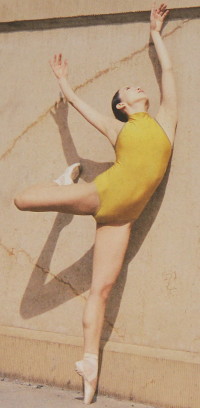 She doesn't so much lift her knee as send it back from the hip. Her's
head is right (not left as in this ballerina). Man looks at woman. This is rather
like the Rudolph Ronde, except the man stretches to lift her leg but
holds his left side back so as not to lead a ronde. There is no ronde
and much less rotation.
She doesn't so much lift her knee as send it back from the hip. Her's
head is right (not left as in this ballerina). Man looks at woman. This is rather
like the Rudolph Ronde, except the man stretches to lift her leg but
holds his left side back so as not to lead a ronde. There is no ronde
and much less rotation.
|
In Cherry Heart
by Shibata we dance a reverse wave;; back feather; back three step;
pivot 3 to CP DRC; side to eros line; recover to hinge facing COH; side
to turning hover to SCP DLC;
|
| Tumble Turn
phase VI
sq&q;
or maybe
q/&qs;
or
q&sq;
"The music tells you what to do."
|
In closed or banjo position facing RLOD,
trail feet
free, step back R lowering and beginning to turn LF. Step side and back
L with R sway (W strongly side and forward R to remain in closed
position).
On the "&" the man sneaks his R across to a contra banjo, line of
dance, and rises with right side stretch, opening her head; she crosses
behind. Lead feet brush up to trail as both swivel on the trail foot to
face
center, and he steps forward L pivoting a little LF and lowering into a
"contra" closed position facing COH or DRC.
This last step contains the "tumble" action, and the
figure might be more descriptively called a "feather finish to a tumble
ending." It is a little like a contra check. The actual step is
shorter, but she has stepped side and back to move from tight contra
banjo to closed, and he steps forward into her with right side lead
(contra), lowering.
The
pretty part of this figure is really the swivelling
in contra banjo and the tumble to closed, so the music might tell you
to dance the sequence in a way that gives more time to these parts. To
make a picture out of the tumble, dance q&qs. To feature the rise
and turn, dance q&sq.
|
In Puppet On A String
by Bahr (1990), there is a natural weave;; fwd right lunge recover
(SQQ); tumble turn (SQQ&);
In the Goss' My Guy, there is a closed
telemark; natural weave with tumble ending (sqq qqq&q);; step ronde
(woman syncopated pick up lock) fwd; slow right lunge;
In Make Believe A
Dream by Patrick, there is an open impetus; running open natural
turn; tumble turn; feather finish; three step;
A video of Ron & Ree Rumble teaching the tumble turn.
A detailed look by Egils Smagris,
at the feather; reverse turn;; three step; then the reverse turn half;
tumble turn; feather finish; and finally the feather; reverse turn
half; tumble turn; back to promenade sway; oversway; change sway &
hover out to SCP;
|
| Rumba
Cross
phase VI
qqqq;
|
In closed position facing LOD,
step forward L (woman back R). Knees are soft. Use strong left side
lead and left side stretch. On the second "quick" cross right in back
of
left (woman left in front of right). Use a Latin Cross action with the
heel leading, R toe to L heel, making a momentary "7" and turning RF up
to 1/2 on the toes. This strong left side stretch will cause/allow the
woman to
cross in front. On the third step, step back L, pivoting RF 1/2. On
beat 4,
step forward R to closed position. Standard amount of total turn is a
full turn but may be under or overturned.
A syncopated timing (e.g., q&qs;) may be more
commonly used.
|
Hicks-Boaz workshop
|
| Big Top
phase VI
sqq;
|
In semi-closed position, trail feet free,
step thru like a chair, commencing a LF spin. The man leaves his left
leg extended back with the left knee tucked behind his right knee. As
he spins on his right, his left rotates "as one" and remains extended
behind. During the first of the two quicks, the woman steps quickly
side and forward to closed position, continuing the spin, and then the
man steps back, crossing his left well under his body with right side
stretch. During the second quick, he rises, no sway, and slips back R
(she forward L) in closed position. Total rotation is about 3/4 LF.
Notice that the timing is a little different for the man
and the woman. She takes her second step at the beginning of that beat,
and he delays taking his step until the end. We can describe the
stepping in this figure as "we, she, he, we." The Bucks, in Dance
and Dream, give the count as sqq for the man and qsq for the
woman. The Worlocks, in Until Now, give the count as qsq for
the man and q&-q for the woman.
One teacher compared the big top (phase VI) to an
amalgamation of phase IV figures: a chair and slip and a cross
hesitation. More specifically, the big top is like a chair with a
strong cross hesitation rotation and then the slip action.
It is hard to get the full spin. I've heard the cue "big
top to face line" and thought, this should be cued "Huge Top." The man
needs to use upper body rotation to lead the woman's second step. She
needs to close up to the man, stay centered on his body, and keep her
head strongly left, and he needs to stay down during the spin. Rise
only at the end of the spin and then slip back. The
second step is not a big one for the lady. It is easy to want to reach
out, trying to get around, but the lady's second step is close to the
man's right foot, which he hasn't released yet. Her right foot is next
to his right foot, which puts her on his right side, in good closed
position. If she takes a big step, it will put her on his left side.
Don't do the big top in SCAR. This is a spin on one spot, the spot of
the lady's second step; it is not a "runaround" or wheel. She then
collects her left foot as he takes his second step and his third,
slipping back step, and she only then slips into him and takes weight.
|
In the Worlocks' Until Now, part
D begins with a telemark to semi; open natural; open impetus; promenade
weave;; whisk; big top; three step; to a natural weave;;
Hurd figure clinic (mp4) on waltz and foxtrot big top (at 37:55)
|
|
|
|
|
Here are some American figures
that are
not used in round dancing but are common in freestyle dancing.
|
|
| Basic ("magic" step)
ss; qq
|
Step forward L (W bk R) in closed
position, -, forward R, -; side, close,
|
What's "magic" is that you end with your
lead foot free. You can repeat these steps all night long. |
| Basic Backward
ss; qq
|
step back on the lead, -, back, -; side,
close, |
Alternating the basic forward and backward
will allow you to weave among the other dancers on the floor more
effectively. |
| Turning Basic
ss; qq
|
forward L in closed position, -, back turn
LF 1/4, -; side, close, |
|
| Basic to Promenade
ss; qq
|
forward on lead feet & open away from
partner into semi (=promenade), -, both forward, -; side & turn
back to partner, close, |
|
| Basic with Underarm Turn
ss; qq
|
forward on lead & open away from
partner to semi-closed position, -, both step forward & man raise
left arm, -; side & woman turns RF under man’s L arm, through to
face partner as she finishes turn, |
|
| Side Rocks
ss;
|
In closed position, step to the side L,
draw R to L without weight, step to the side R, draw L to R without
weight; |
|
Promenade Walk-Around
ss; qq
ss; qq
|
In SCP LOD walk 2; W
unwind M LF 2 Q to CP RLOD ,, rock fwd L (W bk R), -; Rec R trng LF to
CP Wall, -, sd, cl;
|
|
Footprints from Shall We Dance by Eric Zimmerer, Ace
of Hearts Publishing, Sunnyvale, CA, 2003, and Ballroom Dancing
by Alex Moore, Routledge Publ, NY, 2002.
|