|
|
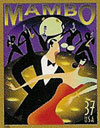
Mambo—
4 beats/measure; 44 - 50 meas/min
Mambo originated in Cuba and is their national dance. It came
to the United States in the '40s and became widely popular in the early
'50s. Teachers promoted it and even developed three separate rhythms:
the single, double, and triple Mambo, something we also see in our Jive and
Swing today.
As a first approximation, Mambo is a fast Rumba. Many of the
figures are the same as in Rumba or Cha, but to get them done in less
time, you must take smaller, sharper steps with a somewhat tighter
hold. The rhythm is down in the floor and choppy. Where Rumba is smooth, Mambo is quick and sharp.
Each figure has a staccato, rocking appearance and then a pause as
though you are catching your breath before the next figure. Given the
speed, the hip action is less pronounced. Take each step on the inside
edge of the foot early in the beat, then shift weight to the flat at
the end of the beat and straighten the leg. Taking weight and flexing
the off knee draws the supporting hip in the direction of the step, so
the appearance is that of stepping with the foot and then the hip. The
timing would be something like "&/1" — "edge/flat." Count: &1,
&2, &3, pause; but count fast.
Figure Name, Roundalab Phase
Level, & Timing
q=quick, 1 beat
s=slow, 2 beats
&=1/2 beat; a=1/4 beat |
Steps and Actions That Make Up
the Figure
Each description focuses on the man,
with the woman's footwork in parenthesis. If a woman's step is not
given, it is the natural opposite or follow of the man's. Help: basic dance
positions and steps,
actions, directions, and abbreviations. Non-standard punctuation: a
comma separates two beats of music, a semi-colon marks the end of a
measure, and a slash (/) indicates a split beat, two things occurring
in a single beat.
|
Here are some sequences to help
you visualize the figure in context.
|
| Basic
phase III
qqs; qqs;
|
In closed or butterfly position, step forward L (woman
back R), recover, side, -; back, recover, side, -;
One might be asked to do a half basic or Forward Half Basic,
the first measure of this figure; or a Back Half Basic, the second measure.
|
In the Kincaids' Let's Mambo Tonight, the dance
begins with a cucaracha left & right;; full basic;; new yorker to
reverse and kick to line; knee swivels; new yorker to reverse and kick
to line; side walk to reverse; to a scallop;; |
Forward Basic
phase III
qqs;
|
In a facing position, step fwd L (W bk R), rec R, bk L -;
If partners are both facing the same direction, as in OP or LOP, then
the steps for both are fwd, rec, bk, -; and may begin with either
foot and with opposite or same footwork.
|
In Fragilidad by Suss, there is a diamond turn;;;; fwd basic; cucaracha w/ tch; scallop;;
|
Back Basic
phase III
qqs;
|
In a facing position, step bk R (W fwd L), rec L, fwd R, -;
If partners are both facing the same direction, as in OP or LOP, then
the steps for both are bk, rec, fwd, -; and may begin with either
foot and with opposite or same footwork.
|
|
| Closed Basic
qqs; qqs;
| In closed or butterfly position, step forward, recover,
close, -; back, recover, close, -; | In Sing A Long Mambo by the Worlocks, part B
begins with side walk 3 to open position facing LOD; chase turn away to
face RLOD; fwd 3; patti-cake tap; back basic to butterfly; thru to
serpiente with flick & knee lift;; thru side close; closed basic;;
open up to a cucaracha cross check; rec sd thru to butterfly; |
| Progressive Basic
phase IV
qqs; qqs;
|
In closed, butterfly, or left open facing position,
rock forward L (woman back R), recover R, back small step on L, -; rock
back R, recover L, and small forward R, -; |
|
| Mambo Walks
qqs;
|
Step fwd, fwd, fwd, -; |
|
| Cucaracha
qqs; qqs;
|
Step sd, rec, cl, -; sd, rec, cl, -; These side steps
are pressing steps; full weight is not taken. So in the first measure,
you step to the side with your lead foot, press with the ball of the
foot, but don't lower the heel and don't raise the heel of the trail
foot. A little rotation of the ball of the lead foot would be
appropriate, but in mambo we don't have time for much of this sort of
flourish. Then recover full weight to the trail foot, and close the
lead foot to the trail foot. |
In Mambo Loco by Pilachowski & DeLauter,
there is an alemana;; shoulder to shoulder twice;; cucaracha left &
right;; basic;; |
| Turning Cucarachas
qqs; qqs; qqs; qqs;
|
The cucaracha is not standard for mambo, and the
turning cucaracha is even less standardized. Of course, the footwork is
some number of cucarachas, but we turn either LF or RF, usually 1/4 or
1/2, on either the first or second step of each cucaracha.
So, we might begin facing partner and wall with lead
feet free. Step sd L (W sd R), rec R turning 1/4 RF (W rec L turning
1/4 LF) to LOP facing RLOD, close L, -; sd R, rec L turning 1/2 LF (W
1/2 RF), cl R to OP facing LOD, -; sd L (W sd R), rec R turning 1/2 RF
(W rec L turning 1/2 LF) to LOP facing RLOD, close L, -; sd R, rec L
turning 1/2 LF (W 1/2 RF), cl R to OP facing LOD, -;
|
In Bamboozle by the Teagues, there is a
diamond turn to CP wall;;;; turning cucarachas to OP LOD;;;; back
break; swivel walk 6 to face;; hip rock;
In Bye Bye Mambo by the Rumbles, there is a
scallop to CP wall;; two turning side breaks (which are essentially
turning cucarachas), one turning 1/4 to LOP RLOD and the second turning
1/2 to OP LOD;; to a side break to rolling off the arm to face LOD;;
|
| New Yorker
phase III
qqs;
|
In butterfly position, both swivel on the trail foot to left open
position and step through to RLOD, recover to face again, side toward LOD, -;
May begin with the trail foot free, in which case we would swivel to
open position LOD and step thru to line. May be done in other dance
positions and other facing directions.
|
In Ding Dong Mambo by the Collipis, we start
with a basic;; new yorker twice;; spot turn twice;; mambo box;; |
| Spot Turn
phase III
qqs;
|
In
butterfly position, both swivel 1/4 and step fwd turning 1/2. Starting with lead feet, the man would turn right face, and the
woman would turn left. Recover and turn 1/4 to face partner.
Then both step side. |
In Ding Dong Mambo by the Collipis, part A
starts with a basic;; new yorker twice;; spot turn twice;; mambo box;; |
| Break
phase III
qqs;
|
To break is to step back and maybe cross behind. Then
you recover and step to some indicated position. The cue might be break
back to open, in which case, you would cross behind with the lead foot
turning LF (woman RF) to open position, recover on the trail foot, and
step forward on the lead still in open position, -; Or you might be
asked to break back to face, in which case, you would cross behind
turning to open, recover turning back to face partner, and then step
side to a facing position, -; The break can begin with either foot. |
In the Worlocks' Jack Is Back, you are facing
wall and partner in handshake for a break and pull pass. This is simply
one measure in which you break apart L (woman apart R), pull right
hands passing right shoulders, and step forward (man to wall; woman
toward center). The dance continues with a chase turn to left
handshake; break & pull pass; chase turn to join lead hands; break
& wrap to face reverse; and wheel to face line;
In Mambo With Papa by the Aurienes, there is a
forward and back break;; left and right break;; side walks to line;;
cross body face center;; repeat to face wall;;;;;;;;
|
| Open Break
phase III
qqs;
|
In a facing position holding lead hands, both rock
apart on lead foot trail hands up palms out, recover, and step side, -;
Mambo is fast. It's always important to keep steps small, to keep your
partnership compact. A small modification here that feels good is for
the man to break not apart but to the side (small step). His steps
become sd L, rec R, sd L, -; and we don't get so far from each other.
The lady still breaks apart.
|
In 1+1 Is 2 by Worlock, in part A we dance an open break; to nat top 3; surprise check; rev top 3;
In part B we do open break lady spiral; cumbia; open break lady spiral; cumbia; both underarm turn; cross body;
|
| Side Breaks
ss; ss;
|
In a facing position, step side L (woman sd R), -, sd
R, -; close L (woman cl R), -, cl R, -;
This style of break is more commonly associated with
jive or swing.
|
In Hey Mambo! by the Cibulas, the dance
starts (partners 10 ft. apart) with side breaks with arms up and down;;
4 cross walks together;; and quick cucarachas left and right;; |
Underarm Turn
qqs;
|
In BFLY position trail
feet free turn slightly RF and step back R (W swivel 1/4 RF step fwd L
and turn 1/2 RF), recover L to face partner (W rec R turning 1/4 RF to
face), both step side, -;
The lady makes a full turn RF under lead hands. There is no turn for
the couple as a whole. Usually begins in left open facing position or
BFLY. May begin in any facing direction.
|
|
Reverse Underarm Turn
qqs;
|
In
butterfly position, man facing wall, cross in front with lead foot (W
swivel 1/4 LF step fwd R and turn 1/2 LF), recover R (W fwd L turning
1/4 LF to face ptnr), and both step side, -;
The lady makes a full turn LF under lead hands. There is no turn for
the couple as a whole. Usually begins in left open facing position or
BFLY. May begin in any facing direction. |
|
| Natural Top
qqs;
|
In closed position, reverse line of dance, cross right
behind left and turn in a tight circle RF, step side turning to face
wall, close; |
Half basic to a natural top. (In such a sequence, turn
the half basic 1/4 RF to prepare for the top.) |
| Chase
phase III
qqs; qqs; qqs; qqs;
|
Facing partner, step fwd L (woman back R) and turn RF
1/2, recover, fwd, -; This puts you in tandem both facing center. Step
forward and both turn (man LF and woman RF), recover, fwd, -; At the
end of the second measure, you are in tandem, both facing wall. Step
forward she trn 1/2 LF, rec, bk, -; bk, rec, fwd, -; You end in facing
position as at the start. |
In Mambo Istanbul by the Collipis, there is an alemana;; shoulder to shoulder twice;; slow side close twice;; chase 3/4 to face;;; aida;
|
Chase Full Turn
qqs; qqs;
|
In a facing position, fwd
L trng 1/2 RF (W bk R), rec R trng 1/2 RF (W rec L), cl L to R (W cl R
to L), -; bk R (W fwd L trng 1/2 RF), rec L (W rec R trng 1/2 RF), cl R
to L (W cl L to R), -;
Note that the man makes a full turn during the first measure, and the woman makes a full turn during the second measure.
|
In Chihuahua by the Worlocks, there is a chase full turn blending to BFLY;; sd cl sd flick; behind sd cl;
|
Chase With Underarm Pass
phase III
qqs; qqs;
|
In left open facing position step fwd L comm 1/2 RF turn (W bk R),
recover fwd R keeping lead hands joined, fwd L, -; back R raising
lead hands (W fwd L), recover L (W fwd R turning 1/2 LF under joined
lead hands to face partner), small side R, -;
Figure might begin in BFLY wall and end BFLY COH. May be done in any facing direction -- turns 1/2. |
|
| Cross Body
phase IV
qqs; qqs;
|
Facing partner & wall, step forward L (woman back
R), rec, sd turning LF (woman steps fwd to "L position"), -; step back
continuing to turn LF (woman fwd turning LF), step fwd (woman fwd
turning 1/2 LF), and side to butterfly center, -; |
In Easterday's Jambo Mambo, there is a half
basic to a cross body twice;;;; and then a vine 8;; |
| Aida
phase IV
qqs;
|
In OP LOD trail foot free XIF stepping
through to line beginning to turn in (man RF woman LF), fwd continuing
turn, bk to V back-to-back position man facing rev & cntr woman
facing rev & wall, -; (may begin to reverse with lead feet)
A little better is to take two
forward
steps, trail foot then lead foot, no turn, and on the & of beat 2 sharply turning 1/2, M RF, W LF, and stepping back
into the aida position on beat 3. Instead of a rounded look, we have a crisper,
more proud, more deliberate look, which is very mambo-y.
|
half basic; aida; roll to reverse and face; cucaracha
to semi; scallop;; |
| Roll
qqs;
|
In aida position step fwd turn in 1/2, bk continue
turn, fwd turn to face partner and wall, -; |
In the Easterdays' Who's Got the Mambo?, there
is a forward basic facing line of dance (woman reverse); both roll RF
to reverse; natural top to face wall;; and cucaracha twice;; |
| Scallop
phase IV
qqs; qqs;
|
In a loose closed position, cross lead foot behind
trail foot, recover, and step side, -; step thru, sd, cl, -; Keep your
shoulders parallel and even hold eye-contact. Swivel at the hips but
don't open your top-lines. End in butterfly or closed position.
As you take each side step, trace a curve on the floor —
the Scallop is named for these "scalloped" arcs.
|
Again from Jambo Mambo: open break; natural
top; scallop;; repeat;;;;
Or, scallop;; scallop;; scallop;; side walk 3 to bfly;
fence line;
|
| Patty Cake Tap
phase IV
ss;
|
In left open position facing reverse, lift trail knee
swivel in to face partner pat trail hands and point trail feet thru
toward line no wt, -, lift trail knee again and swivel back out again
to left open and step back, -; (one weight change total) |
Try a cross body to left open position facing LOD;;
back basic; patty cake tap; back basic; patty cake tap; back basic;
kiki walk 3; new yorker to face; whip back to wall; |
| Diamond Turn With Hops
qqs; qqs; qqs; qqs;
|
This is a waltz or fox-trot figure, but if you add the
hops, it becomes latin‽
In closed position wall or line, step fwd L turning LF
to bjo, sd turning, bk, lift right knee and hop back a little still on
left (three weight changes and a quarter turn left in each measure); bk
R, sd, fwd, hop fwd; fwd, sd, bk, hop; bk, sd, fwd, hop; (end in
starting position)
|
In the Schmidts' Mambo Tequila, the dance
begins with two cucarachas;; diamond turn with hops;;;; to a full
basic;; new yorker; and underarm turn; |
| Vine
qqqq;
|
In loose closed, step side, behind, side, in front;
(really, a two step figure) |
Repeat for a vine 8 |
| Arm Check
phase V
qqs; qqs;
|
In left open facing position, rock apart L (woman apart
R), recover R, and step side and forward L toward woman's left side
(woman forward R toward man's right side) release joined lead hands and
take woman's left wrist in man's right hand, -; In second measure, he
steps forward R turning 1/2 LF and leading woman to spin 1 & 1/2 RF
in 3 steps with a little push to her L wrist, forward L, close R, -; |
|
| Tummy Check
qqs;
|
Unlike the arm check above, this one doesn't turn.
Facing partner, check forward R toward partner's R side
(W fwd L) catching partner with R arm at waist, recover, back & sd
R (W bk & sd L) to face partner again, -;
|
In Moola Lah by the Finches, there is a
basic;; open break; tummy check; open break; underarm turn; |
|