 |
ROUND DANCING — CHOREOGRAPHED BALLROOMEDUCATIONAL ARTICLESMAJOR SECTIONS: Figures | Articles | Links | Alph. Index | Search | Home |
|
|
BE GENTLEby Harold & Meredith Sears Dancing certainly is a contact sport. But it is not wrestling,
football, or boxing. Let’s not use full body throws, body slams,
tackles, or left jabs (unless they’re cued, of course I wonder if we are writing mostly to the men, here? Is the roughness that we sometimes see on the dance floor some kind of primal caveman or he-man urge, one of those Y-chromosome things? Mostly, but maybe not entirely. Anyone can be over-enthusiastic, intense, rushed, or pushy. In round dancing, we focus so strongly on the steps, the figures, the whole choreography — we focus so strongly on our feet — that the “details” like gentle execution can be overshadowed and forgotten. Moderation —One way to cultivate a gentle style is to make our movements and steps soft and smooth—not sharp, not sudden, not jerky. Well, some dance steps should have some abruptness to them. An Alemana Surprise Check or a Surprise Whip should have a surprise in it, but a gentle surprise. A Contra Check or a Right Lunge in tango should get out there and then stop, but not roughly or brutally. Let’s not try to make business for the chiropractor. As in most aspects of life, we want moderation—some sharpness when called for, but not too much. For instance, we know that long, gliding steps often look good. Some seasoned round dancers sweep past the beginners, on the inside of the curve. Maybe we have watched competition ballroom dancers soar from one end of the floor to the other. But sometimes, in striving to reach an imagined goal, we go too far, and a gracefully reaching step becomes a sudden leap or lunge. Then, the resulting momentum is hard to resist, so recovery must be muscular and crudely jerky in its turn.Pay attention to whether you are on the inside or the outside of any curve. On the inside, take smaller steps so she doesn't have to hustle. And stay tight in; again, she'll have a shorter arc to navigate. The same goes for her when you curve or turn the other way. We strive for rise and fall in most of the smooth rhythms, but it too should be gentle. There should be no hint of a jack-in-the-box. Don’t pop up to the tippy-toes and then thump down onto the heels. No deep knee bends. No abrupt extensions. We strive for sway and change of sway, but don’t jerk or shove your partner. We try to use side lead and contra action. Ease into these upper body rotations. Don’t throw that side forward like a race driver jerking the wheel of his hotrod. Much of our dancing involves turning—moving from one side of our partner to the other. If you try to go around your partner, sometimes it is a long way and you will have to rush or leap. Instead, go through your partner. For instance, in an Open Telemark, the man’s first step is forward with his left foot. Now, make the second step straight forward with the right; not side, not around her, but straight through her left side. She will turn ever so neatly, like a revolving door, and you are through to the other side—smoothly, gently. Often, choreographers will ask for arm- or legwork that is not a part of the standard figure. We are taught to dance a Fence Line “with arms.” That particular dance is popular, we dance it often, and we get into a rut and begin to dance all Fence Lines with arms. She is asked to recover from the Fence Line and kick to a Same Foot Lunge Line. Maybe the music has a nice flourish right there, one that calls for that kick. But humans like to develop habits—habits cut down on the number of decisions we have to make. So we begin to kick our way from every Hinge into a Same Foot. If the musical flourish isn’t there, then it looks busy, maybe frantic. If the tempo is a little faster, then the extra piece of business might appear rushed. If the music is more dreamy, then a flick might appear out of place. Don’t let such ruts trap you. Don’t do every Open Break with a big, vertical arm thrust. Don’t dance every Cross Body with a twirl. Don’t struggle to turn every Lariat into a Rope Spin. Don’t struggle at all—be gentle. Think Ahead —We are told to “develop” or “extend” a picture figure. Usually, this means to add a little more to what you have already done to get into that shape. Turn your bodies a little farther, lean back a little more, or extend a free arm to follow the line of the body. Well, again, in a waltz or a foxtrot at least, don’t just throw yourself out there and then stand there in a static pose. That’s going to look rough. Maybe the most valuable skill, to make dancing smooth and gentle, is to use all the time that is available. Arch back slowly. Extend the arm smoothly, over the whole measure. Do you have two measures? Use every beat. Another smoothing strategy is to anticipate the next figure, even as you are dancing the current figure. You can think of this as preparing or “prepping” for each figure as it approaches. For instance, if you are dancing a Three Step and then a Natural Weave, you will hear the second cue as you dance the Three Step. As you hear that next cue, adjust the last step of the current figure. Turn it a little to the right, and you will flow so much more gently into the weave. If you’re doing hip rocks to a spot turn, on the last hip rock, turn your foot out to allow the spot turn to flow. As a matter of fact, listen for that word “to” in the cueing. “Open break to a Natural Top.” The “to” warns you that you especially need to prep, in this case, to turn the end of the Open Break to the right so that the Natural Top will flow smoothly. In essence, you have begun the Natural Top at the end of the Open Break. You are overlapping the figures. No, we don’t want to be sloppy, but if we can consciously transition from each figure to the next, with a small action or maybe only with a mental readiness, then we will have one smooth dance, rather than lots of separate, isolated, and choppy figures. As much as anything, familiarity with the figures lets you “gentle” the movements. If you don’t know the figure well, you spend part of the beat hearing the cue, recognizing the name, putting the name to the actions, and finally getting the nerve impulses started on their way to the appropriate muscles. By that time, the beat is almost spent, and of course you have to jump into it. After you’ve done a figure or a dance 20 times, all that “thinking” happens a lot more quickly, leaving more time for gentle execution. Ah yes—here comes a blinding flash of insight. Are you ready? If your dancing feels rough, then practice can help smooth out the flow. Lead But Don’t Force —Men, your job is to lead your partner. Is “leading” the same thing as “making her go where you want her to go?” Do you ever find yourself dragging her across during a Wing? Don’t do the caveman thing. Be gentle. Guide, suggest, invite, but don’t force it. Open the door for her in a gentlemanly fashion, but don’t push her through. If she doesn’t get quite as far as you thought she should, let it be. A smaller move will certainly look better (and feel better) than a forced “correct” move. A good dancer is not an individual but very much a part of a couple. He must give her time to execute her moves. He must know what she has to do, lead her to do it, help her to do it or at least allow her to do it, and only then move to the next step or figure. Don’t do what the music tells you to do, regardless of what else is happening in your partnership or on the floor nearby. Adjust. Dance not only to the music, but to the total environment. You look good only if you both look good. At the end of the dance, let’s not hear her say, “You danced as though I wasn’t even there. You danced for yourself.” And don’t you reply, with great authority, “Follow! Just follow!” We talk casually about “lead and follow,” as though the information flows only from the man to the woman, from a captain to his crew, but it is really a conversation. He offers a lead, she responds, he reads that response and uses that information to fine-tune his next lead. A caveman lead is rough and awkward. A conversational lead is smooth and gentle. Thank Your Partner —And finally, at the end of the dance, you have one more opportunity to be gentle. Since even the hardest working, most practiced, and most highly polished dancer is still human, you might be tempted to question those blunders that will occur. This question could be as harsh as, “What kind of STUPID move was that?” The question could be less emotional—“Why did you do a Reverse Turn when the cue was Reverse Wave?” or “Why won’t you keep your arms up and give me something to work off of?” If you can ask this sort of thing with a bit of a smile or twinkle in the eye, then it can be fun. You can laugh at yourselves and still feel as though you’re partners. But if there is a feeling of irritation, frustration, or anger in your tone, then you are not together, not a couple, and a lot of the fun disappears — poof — it hurts and deflates what might have been a pretty party balloon. There are only three emotional combinations: When both are happy with the performance, then it is easy to be gentle and easy-going in your relationship. When both are unhappy, then a little grousing might not do too much damage. You can wallow in the mud of frustration together. But if only one is unhappy, then you need to take care. One has enjoyed the dance and feels good; the other feels short-changed and slighted. He didn’t do his part, or she didn’t do hers—didn’t measure up. But what percentage of the dance did these shortcomings really occupy? Now, at the end of the dance, is the time to think of the good parts. Now is the time for, “Thank you.” “That felt good.” If it didn’t feel good, at least the music was sweet. Smile. Be gentle.
See our related article — “Don’t Fight”
This article was published in the Dixie Round Dance Council (DRDC) Newsletter, February, 2007; reprinted in Footnotes In the Round, LRDTA, 27-2:8–9, 2/2007, and again 27-12:7–10, 12/2007; excerpted in the Dallas Harvest Holiday 2007, 47-3:1–2, 3/2007; reprinted in the Roundalab Journal, 31:3, p.19–20, winter 2007/08; and an edited version was published in Round Notes, CRDA, p.6, April/May 2008.
If you would like to read other articles on dance position, technique, styling, and specific dance rhythms, you may visit the article TOC. Past DRDC Educational Articles archived here. Go beyond this site. Find other references on our Sources and Links pages.
|
 |
|
|
Page last revised
 ).
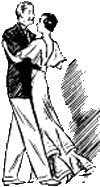
We are dancing with a partner, not an opponent. So we should try to be
gentle.
).
We are dancing with a partner, not an opponent. So we should try to be
gentle.