 |
ROUND DANCING — CHOREOGRAPHED BALLROOMEDUCATIONAL ARTICLESMAJOR SECTIONS: Figures | Articles | Links | Alph. Index | Search | Home |
|
|
Dance Position and Connection Between Partners
by Harold & Meredith Sears So important is your dance position and the connection between you and your partner. Before you can move as one, lightly and smoothly around the floor, the gentleman's lead clear and unambiguous, and the lady's follow responsive and precise, you have to get into position and be connected.Closed Position—The fundamental dance position, and the one in which you can feel most connected, is Closed Position. Good connection and smooth lead and follow come from a toned frame in the upper body and contact at the hips (diagrams for some positions are available in the table below). In the Smooth Rhythms, such as Foxtrot, Waltz, Tango, and Quickstep, you face each other, offset, each to the other's right and each looking to the left, over your partner's right shoulder. Think of the space between your partner's head and right shoulder as your "window," and try to look out of that window at all times. You will be tempted to gaze into your partner's eyes. After all, you are in each other's arms, the light is low, and the music is romantic—but don't do it. Keep your eyes left. If you look right, you will drift right and invade your partner's space. Then you will start to bump and step on each other’s toes. Stay in your own space, and look out of your own window. A forward step with your right foot should slide neatly between your partner's feet.Now, stretch the right side of your torso a little, without crunching or collapsing your left side, and so move your upper body (not your hips) even more firmly into its own space. Arch back just a little, not by leaning away at the waist, but by filling your lungs, lifting your chest, and rotating your shoulders up and back. Be careful not to lift your shoulders stiffly and tensely toward your ears. Don't arch so far back that you appear to be searching the ceiling fixtures for cobwebs. In Closed Position, your upper bodies should be well apart, but our theme is connection between partners. How can we have both separation and connection? Our first level of connection is through well-toned arms. The man's right arm is around the woman with his wrist high under her shoulder and his right hand on her left shoulder blade. The fingers are together and pointed somewhat down. Don't spread the fingers—such a hold looks a little "gropey." Don't let the arm droop—you won’t have connection, and she won't be able to feel your lead. The woman's left arm lies gently on top of his right with her left hand resting softly on his shoulder, like a little bird perched upon a branch. The hand is arched. Her finger tips are a little behind his upper arm or shoulder, and her thumb is a little in front, but don’t grip. Don't let the hand climb up toward his neck, and don't hang on him. Each of you must support your own weight. The man's left arm should similarly be raised and extended out to the side. The upper arm slopes slightly down, and the forearm slopes upward. The woman will place the palm of her right hand into the palm of his left, resting her fingers in the cradle between his thumb and forefinger. Both of you fold your fingers softly over the hand of your partner. Don't bend the wrist back. Again, don’t grip tightly. Each of you must support your own arms. This is what muscle tone does. If you release your hold and step back from each other, you should be able to maintain your position comfortably. You should not feel suddenly unsupported. Your arms should not flop to your sides. Your own muscle tone should still provide firm body support.
It is so easy to let your elbows fall to your sides and to let your shoulders droop forward, leaving you hunched over your partner like a vulture over its prey. So keep your arms up and your toplines up. You must make adjustments if you are of significantly different heights or girths, but the ideal that you strive for is a horizontal oval described by the arms and shoulders. His left hand is above this plane, and his right hand is below it, but this oval is your "frame." Keep tone in all the muscles of your upper bodies so that this shape is maintained. Now, notice what a toned frame does for partner connection. When the man steps back, his right arm maintains its position — you maintain your frame — and the woman feels the movement at the fingertips of her left hand, throughout her left arm, through the pressure on her back, and through a release of pressure at her right hand. Men, don't pull her toward you by bending your elbows. Simply move and so draw her toward you. When the man steps forward, she feels this movement at the pad of her left thumb, along her left arm, and at her right palm, and the pressure of his right hand on her back releases. The woman is maintaining tone in her upper body and should be maintaining gentle pressure into his right hand, so she feels not only the movement but the release too, and she automatically moves to recover or reclaim the pressure. If he moves right or left, or if he turns one way or the other, his frame moves as a unit and conveys this movement at many points of contact. Ladies, you must maintain tone throughout your frame, too. A conductor cannot direct an orchestra with a piece of cooked spaghetti. Neither can a dancer lead a limp partner. Stand up tall. Arch a bit back. Look left. Arms up. Maintain your muscle tone, feel his movements, and be poised to respond. With toned upper-body frame, you are connected and dancing as a single unit.
Our second level of connection is at the hips, and this point of connection is simple and direct — keep your hips together. In the upper body, the idea of connection is a little subtle. We want the upper bodies apart, and we want connection at the same time. We are using overall muscle tone to accomplish this. In the hips, the connection is not subtle. You simply(!) stay close. Remember, we are dancing offset to the left, so we are not dancing "belly-to-belly." Instead, the slight rise of your right hipbone should fit just inside that of your partner. Can you hold it there as you dance? No matter how fast you are moving or how much you may be pivoting or turning, can you keep your hips up to your partner? (No, we can’t either, but it is a goal we can shoot for.) I read the comments of a ballroom judge once, who complimented a couple on their "immaculate topline and constant body connection. I did not see one gap even with the most complex of material. They are seemingly joined together by super glue." Hip contact tells you where your partner is and where he or she is moving, relative to yourself. We have a powerfully direct line of communication in that contact. If you want to turn right, men, don’t push with the left hand. Such a push will only move your upper bodies awkwardly out of dance position. Instead, anticipate the turn with a little lowering in the knee and a little lower-body rotation, and she will be forewarned. In a way, you will turn her with your hips, not your arms. The results will be smoother, and you will remain continuously in dance position. Men, pay attention to this contact. As you listen to the cues and think about where you have to go, it is easy to dance away from your partner. But your job is to lead her and to go there together. So, don’t turn, spin, or pivot away from your partner and leave her behind. Keep her on your right hip. Often, this simply means stepping through her, rather than past her. Think of the second step of an Open Telemark. If you make that a side step past the woman and down line of dance, you will next turn away from her and leave her way off to your right, sort of hung up under your right armpit. Instead, if you step forward between her feet toward line and center, you will both turn on about the same spot, and you will stay together. Ladies, keep your hips up to his. If you feel your right hipbone leaving its spot just inside his right hipbone, then make any adjustments you can to reclaim your position. Maybe the most valuable thing you can do is to let the free foot follow the man’s movement and not take weight until he does. Then you can take weight in such a way that your hips are in position. So, good connection results from contact at the hips. As this contact becomes more comfortable and automatic, you can soften it and focus more on a gentle connection at the lower ribcage. Also work for a well-toned frame that allows the upper body to remain apart but in communication. Good connection leads to clear lead and follow and from there to smooth dancing.
Now, you might ask, what if I am not dancing with my usual partner? Many people will feel uncomfortable with hip contact at a social dance or mixer. Indeed, when the waltz was first introduced into England in the early 19th century, with its closed position that was almost an embrace, it scandalized some parts of society, and it is still entirely acceptable to dance without body contact and even with six or eight inches between you. You won't be able to attempt the more complicated figures, but with an unfamiliar partner, you wouldn't want to do that anyway. Of course, without body contact, maintaining your upper-body frame becomes just that much more important. Banjo and Sidecar Positions—Banjo and Sidecar are also considered to be closed dance positions, in that the upper body frame is toned, shoulders remain parallel, and the hips remain in contact. We strive for all the points of connection that we had in Closed Position. Our goal is the same clear lead and follow — the same smooth dancing. Banjo is a closed position with the upper body turned just a bit to the right. You can think of turning so that your belly button no longer points in the direction you are going, but your left shoulder or left side leads your progression. Or you can think of “swinging” or “slicing” the left shoulder forward (woman right shoulder back). Having made this upper body turn, your hips are still together, and your shoulders are still parallel with those of your partner, but when the man steps forward with his right foot, he can slide his foot to his left of her right foot. He steps not between her feet but outside. Similarly, if he stepped back with his left, she would step forward with her right, to the outside of his right foot. Any body turn that causes the opposite side to lead as a step is taken (e.g. left side lead as right foot steps forward) is called Contra Body Movement (CBM), and the position therefore is often called Contra Banjo. It might even be helpful to think that your legs are in Banjo, progressing down line, but your hips and upper body are in Closed, facing line and wall. Your hips are together, your right hip bone is in that pocket just inside your partner’s right hip bone, your frame is toned, your upper body is stretched up and left, you are in your own space looking out of your own window. You have good connection. The thing to avoid is simply stepping to the side, with no body turn, and placing right hip to right hip ("banjo"). Such a shift in position certainly allows you to step outside of your partner, but you will have lost your connection, you are farther away from your partner and so will have to travel farther and faster as you turn, and your dancing will be less smooth. Sidecar is a closed position with the upper body turned a little to the left. You lead with the right side forward (woman’s left side back) so that his step forward with his left goes outside or to his right of her left foot. Contra Sidecar is a more difficult position to maintain than Contra Banjo, because it is still a closed position. That means you will step outside of your partner to your right, but your upper body is oriented to your left. This is accomplished by turning as much as possible at the hips, not higher up. Your goal is to have your upper body in Closed Position, maybe facing line and center, as your steps progress down line. Open Positions—Of course, we make use of many more dance positions than the closed positions. In Butterfly, we remain facing but we are apart (see the table below for details). In Semi-Closed, Half Open, and Open, we turn more and more away from each other. Especially in the Latin rhythms, the man's right hand might move to the woman's upper arm. The man's left hand might come down to waist level. In Hustle, an L-shaped Closed Position is used. But in all of these looser and more open positions, muscle tone, frame, and body connection remain important. For instance, in moving from Closed to Semi-Closed Position, don’t pull your left side from her right side, hinging your partnership to a partially open and unattached position. Turn you bodyline to the right, stretch your right and her left sides a little, and keep your hips together. Her head will open and look down line, and your lead shoulders will separate only the slightest bit more. You might swivel a bit on the balls of your trail feet (man to the left and woman right), and your lead feet will be pointed down line and ready to step down line, but your bodies will be together and connected. In Half Open, don’t simply turn 90º apart, as though you are mad at her. Maybe look half-left and (ladies) half-right, but orient your bodies a little closer. You mustn’t let your heads turn toward each other, but your center can be focused on her center; your belly buttons can look at each other. In leading a Cross Body, point your foot half-left, but turn your body less. Remain aware of your partner, centered on your partner, and with as much tone and contact as is possible. Someone once said, you aren’t really dancing together if you aren’t dancing together. Above, we focus on the importance of good dance position and firm connection between the partners in the Smooth Rhythms, such as Foxtrot, Waltz, and Quickstep. In the “closed” positions, such as Closed, Banjo, and Sidecar, we try at all times to maintain a toned upper-body frame, to keep the woman firmly in the man’s right arm, and to keep our hips and lower ribcages together. Our goal is to create a single connected frame and to dance as a unit. He doesn’t use his arms to push or pull. She doesn’t lag behind and then run to catch up. He doesn’t run away, or more likely, turn away and leave her hung up in his right armpit. Instead, we dance together, as one.“Toned” does not mean stiff or rigid. You want your connection to be elastic. As you drift apart, the biceps of the upper arm hold and stretch a little; as you come together, the triceps and pectorals firm up but still give. The result is that you don’t move apart and together much, but you springily stay in your frame. Think of a heavy-duty rubber band connection, not a welded or bolted connection. Within this frame, his intentions and movements are transmitted to her through many points of contact, from the knees on up, and she is poised to respond to these signals and to stay in the frame and on his hips. Maybe the single most important key to good connection is simply keeping your left side in. This goes for both the man and the woman. Now, you might think that if the man pushes his left side in toward the woman, and the woman pushes her left side in toward the man, that the result might be an ever-faster spinning to the right. That wouldn’t do. Instead, your response must be to resist that push. Men, stay in front of your partner, turn your left side toward her, and at the same time resist or answer her push with a strong right side. Ladies, stay in his right arm, push your left side in, and keep your right side strong. All of this is simply to say, keep your lower bodies together. Don’t lose your partner. Don’t drift apart. In Semi-Closed and even in Open Position, keep your hips turned toward your partner in acknowledgement that you are dancing with and not merely nearby or alongside this person. Both of you may be moving down line of dance, but there is nothing down there you really care about. You care about your partner. Be aware of, stay centered on, be drawn toward your partner. Think for a moment about In and Out Runs. In this figure, we are progressing down line of dance and moving from Semi-Closed to Banjo to Semi-Closed again. How could we improve our connection? We do it by keeping our left sides in and our hips together. In Banjo, make it a good Contra Banjo, with man’s right side back and hips together, not a right-hip-to-right-hip, side-by-side Banjo with your left sides 180º away from your partner. In Semi-Closed, similarly keep your left sides in. Your heads will be open, and your top-lines are apart, but your hips are together. You have connection. Make your connectedness as continuous as you can, not intermittent. As you step through in Semi-Closed, maintain hip contact. As the man moves across the line of progression, don’t separate and then come back together in Banjo with a bump, but maintain the contact throughout. As you step back, men, and she moves across to Semi-Closed, again help her to roll across maintaining contact. Don’t step away from her and then bring her back into contact (bump). The List—Here is a “master” list of dance positions, taken mostly from Roundalab. Occasionally, choreography calls for us to turn away from our partners, to break our connection — maybe we’re in an Attitude Line or we’re Back-to-Back, and the drama has us spurning or rejecting, we hope only temporarily. But in most positions, most of the time, we should strive for connection. This is a long list, but you have used most of these positions in one dance or another. Were you connected? As you scan the list, can you picture a way to incorporate a little more connection between partners? This connection might involve actual contact, body rotation, body sway, a centering on your partner, mirrored arm-work, or nothing more than a focus on or an awareness of your partner’s position and movement. Round dancing is not simply doing the correct steps in the vicinity of your partner. Isn’t that line dancing? Round dancing is dancing together.
Drawings from Dance A While, Jane A Harris et al, Macmillan Publ, NY, 1988.
A version of this piece was published in the the Dixie Round Dance Council (DRDC) Newsletter, part I, September 2006, and part II, October 2006; exerpts reprinted in Dallas Harvest Holiday newsletter, December 2006, and in Around Rounds, the journal of the Round Dance Association of Victoria, Australia, 9:1, p15, 1-3/2007; 9:2, p30, 4-6/2007; 9:3, p12, 7-9/2007; 9:4, p4, 10-12/2007; and 10:1, p29, 1-3/2008.
If you would like to read other articles on dance position, technique, styling, and specific dance rhythms, you may visit the article TOC. Past DRDC Educational Articles archived here. Go beyond this site. Find other references on our Sources and Links pages.
|
 |
|
|
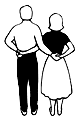 Side by side, man to woman's left,
right hands joined behind woman's back, and left hands joined behind
man's back.
Side by side, man to woman's left,
right hands joined behind woman's back, and left hands joined behind
man's back.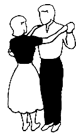 A closed position with the man’s left side
leading. When the man steps forward with his right foot, he steps
outside his partner's feet. Note that the diagram does not show a good
banjo position, but an exagerated, "hip-to-hip" position—they are not
properly closed.
A closed position with the man’s left side
leading. When the man steps forward with his right foot, he steps
outside his partner's feet. Note that the diagram does not show a good
banjo position, but an exagerated, "hip-to-hip" position—they are not
properly closed.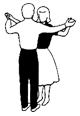 A facing position, somewhat apart
from each other. Lead hands and trail hands are joined at
shoulder height. The elbows are up and out. A couple can be in
"Butterfly Banjo" (left side lead) or "Butterfly Sidecar" (right side
lead). In each of these two cases, the next step would be outside
partner.
A facing position, somewhat apart
from each other. Lead hands and trail hands are joined at
shoulder height. The elbows are up and out. A couple can be in
"Butterfly Banjo" (left side lead) or "Butterfly Sidecar" (right side
lead). In each of these two cases, the next step would be outside
partner.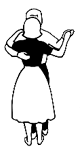 Standard dance position, facing
partner, slightly offset to the left, lower bodies together, upper
bodies apart, both looking left. The man’s right hand is just
below her left shoulder blade and her left hand is on his upper right
arm. His left hand is out to his left and about at shoulder
height and is holding her right hand.
Standard dance position, facing
partner, slightly offset to the left, lower bodies together, upper
bodies apart, both looking left. The man’s right hand is just
below her left shoulder blade and her left hand is on his upper right
arm. His left hand is out to his left and about at shoulder
height and is holding her right hand.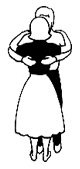 A closed embrace, man's arms around
her waist or lower back and woman's arms on his shoulders, neck, or face.
A closed embrace, man's arms around
her waist or lower back and woman's arms on his shoulders, neck, or face. An open position in which the
woman's left arm is passed through the crook of the man's right arm.
Her forearm rests on his forearm.
An open position in which the
woman's left arm is passed through the crook of the man's right arm.
Her forearm rests on his forearm.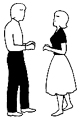 Any position in which the man and woman are
directly in front of each other, front to front, e.g., closed, butterfly, open facing positions, or with no contact.
Any position in which the man and woman are
directly in front of each other, front to front, e.g., closed, butterfly, open facing positions, or with no contact.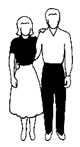 Both
facing the same direction,
womand on man's right side, bodies turned half toward each other; man's
right palm on woman's back and woman's left hand at or near man's right
shoulder. Free arms may be extended
to side. In Left Half Open, she is on his left side.
Both
facing the same direction,
womand on man's right side, bodies turned half toward each other; man's
right palm on woman's back and woman's left hand at or near man's right
shoulder. Free arms may be extended
to side. In Left Half Open, she is on his left side. Partners are facing each other but apart, man's left hand
and lady's right joined. Man's right and lady's left arms may be
extended to the side.
Partners are facing each other but apart, man's left hand
and lady's right joined. Man's right and lady's left arms may be
extended to the side.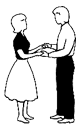 Butterfly postion, but the hands are closer together and
about waist high.
Butterfly postion, but the hands are closer together and
about waist high.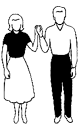 Side by side, lady to his right, man's right
hand and lady's left joined, both looking in the same direction. Free
arms may be extended to the side. Left Open Position is side by
side, lady to his left, man's left hand and lady's right joined, both
looking in the same direction.
Side by side, lady to his right, man's right
hand and lady's left joined, both looking in the same direction. Free
arms may be extended to the side. Left Open Position is side by
side, lady to his left, man's left hand and lady's right joined, both
looking in the same direction.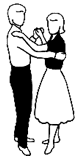 From Closed Position, the man turns 1/8 right
face, and the woman turns 1/8 left face so that his left hip is in
contact with her right hip. Compare to Semi-Closed Position (see
below), where his right hip and her left are together. However, do not
shift laterally. The woman should still be on the man's right
side. His right hand remains on her back, although this hold will
have to be loosened a little. Lead hands remain joined up and to
the side.
From Closed Position, the man turns 1/8 right
face, and the woman turns 1/8 left face so that his left hip is in
contact with her right hip. Compare to Semi-Closed Position (see
below), where his right hip and her left are together. However, do not
shift laterally. The woman should still be on the man's right
side. His right hand remains on her back, although this hold will
have to be loosened a little. Lead hands remain joined up and to
the side.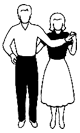 This is a Varsouvienne (see below) in which
the man and woman occupy each other's spot. The partners face the same
direction, the woman behind the man and to his left. She holds
his left hand in her left slightly in front of her left shoulder.
Her right arm passes behind his shoulders, and her right hand holds his
right, again to the side and above his shoulder, or if he is too tall
for this to be comfortable, at his waist.
This is a Varsouvienne (see below) in which
the man and woman occupy each other's spot. The partners face the same
direction, the woman behind the man and to his left. She holds
his left hand in her left slightly in front of her left shoulder.
Her right arm passes behind his shoulders, and her right hand holds his
right, again to the side and above his shoulder, or if he is too tall
for this to be comfortable, at his waist.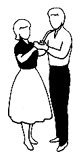 A
position lying between Open and
Closed. In Closed Position, if the man turns his hips to the
right and gives a little more right side stretch, the lady will look to
her right. This is called opening the lady's head. Her body
will open a little, too. It will turn a bit to the right.
Now, your two bodies form a slight "V." Your arm positions have
not changed, and the man's right and the lady's left hips are still in
contact. The lady is still a bit to the man's right, but the
man's left and the lady's right sides are separated slightly, and both
are looking down line of dance. When the man steps forward, the
lady will step forward, too. Note that the man does not turn to SCP; he
truns the lady to SCP, and it is mostly the man's right side that is in
control of the lady's head.
A
position lying between Open and
Closed. In Closed Position, if the man turns his hips to the
right and gives a little more right side stretch, the lady will look to
her right. This is called opening the lady's head. Her body
will open a little, too. It will turn a bit to the right.
Now, your two bodies form a slight "V." Your arm positions have
not changed, and the man's right and the lady's left hips are still in
contact. The lady is still a bit to the man's right, but the
man's left and the lady's right sides are separated slightly, and both
are looking down line of dance. When the man steps forward, the
lady will step forward, too. Note that the man does not turn to SCP; he
truns the lady to SCP, and it is mostly the man's right side that is in
control of the lady's head.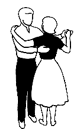 A closed position with the man’s right side
leading. When the man steps forward with his left foot, he steps
outside his partner's feet. Note that, as with the banjo diagram
above, this sidecar diagram is overdone. Their bodies should not be
offset but should be angled and in closed position.
A closed position with the man’s right side
leading. When the man steps forward with his left foot, he steps
outside his partner's feet. Note that, as with the banjo diagram
above, this sidecar diagram is overdone. Their bodies should not be
offset but should be angled and in closed position.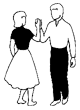 A facing position but offset, right hip to
right hip, woman a little in front of man, right hands joined at
shoulder level or above, right elbows may be touching. In a Left-Hand
Star, each would turn 1/2 and join left hands. The woman would be on
the man's left side and a little in front of him.
A facing position but offset, right hip to
right hip, woman a little in front of man, right hands joined at
shoulder level or above, right elbows may be touching. In a Left-Hand
Star, each would turn 1/2 and join left hands. The woman would be on
the man's left side and a little in front of him.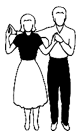 The partners face the same
direction, the man behind the lady and to her left. He holds her
left hand in his left slightly in front and above her shoulder.
His right arm passes behind her shoulders, and his right hand holds her
right, again to the side and above her shoulder. In Man's
Varsouvienne the man and woman occupy each other's spot. The partners
face the same direction, the woman behind the man and to his
left. She holds his left hand in her left slightly in front of
her left shoulder. Her right arm passes behind his shoulders, and
her right hand holds his right, again to the side and above his
shoulder, or if he is too tall for this to be comfortable, at his
waist. In Man's Left Varsouvienne, the man is in front but to
the left. She reaches behind him to join left-left hands held high.
Left Varsouvienne puts the woman in front but to the man's left. All of these are kinds of Shadow.
The partners face the same
direction, the man behind the lady and to her left. He holds her
left hand in his left slightly in front and above her shoulder.
His right arm passes behind her shoulders, and his right hand holds her
right, again to the side and above her shoulder. In Man's
Varsouvienne the man and woman occupy each other's spot. The partners
face the same direction, the woman behind the man and to his
left. She holds his left hand in her left slightly in front of
her left shoulder. Her right arm passes behind his shoulders, and
her right hand holds his right, again to the side and above his
shoulder, or if he is too tall for this to be comfortable, at his
waist. In Man's Left Varsouvienne, the man is in front but to
the left. She reaches behind him to join left-left hands held high.
Left Varsouvienne puts the woman in front but to the man's left. All of these are kinds of Shadow.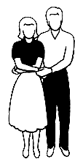 Man stands behind and slightly to the left of
the woman. She crosses her right arm over her left in front of her
body. He holds her right hand in his left. His right arm passes behind
her, and he holds her left in his right at her right hip. A kind
of Shadow.
Man stands behind and slightly to the left of
the woman. She crosses her right arm over her left in front of her
body. He holds her right hand in his left. His right arm passes behind
her, and he holds her left in his right at her right hip. A kind
of Shadow.